Richard T. Ely Quotes
The “natural laws of economics” are in fact tools in the hands of the avaricious and the greedy for keeping down and oppressing the laboring classes.
Richard T. Ely, 1854-1943, Economist, Quoted in Eric F. Goldman, Rendezvous With Destiny, 1952
Sourced by: Eigen's Political and Historical Quotations


Webster was taking regular bribes from large corporations and even complained when his payments were late. So he might have had a pro-large business bias. At the time taking bribes even if there was a quid pro quo was not illegal or even “unethical” by then Congressional rules.

In May of 1886 police had killed some strikers for an 8 hour work day at the McCormick Plant in Chicago. A left wing newspaper called a rally using the word “revenge.” (See {43614}.) The next day, at the rally, someone threw a dynamite bomb killing several police who in turn wounded and killed many of the protestors. 31 people were indicted for the “Haymarket Bombing,” 8 were tried, and 7 were convicted and sentenced to death including Spies. There was however, no evidence linking any of the defendants with the bombing, only evidence linking them with left wing, anarchist positions and writings.


This quotation and other material were so radical and inflammatory that Calhoun wrote and published this anonymously.
One of the contradictions of capitalism is that at many points in history capitalism has caused and/or contributed to great death and suffering. However, that same capitalism has led to the development of science, technology, agronomy, medicine and education which has saved and preserved millions of lives and raised the standard of living more than anything else.


In his economic view, managers, accountants, attorneys, owners, shareholders, landlords, were all supported by the workers who have to support themselves and all the others.


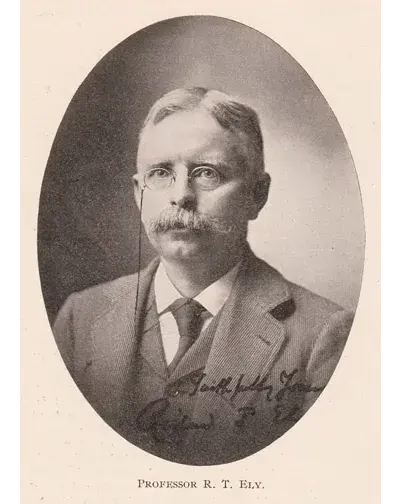
Richard Theodore Ely was an American economist, author, and leader of the Progressive movement who called for more government intervention in order to reform what they perceived as the injustices of capitalism, especially regarding factory conditions, compulsory education, child labor, and labor unions.
