Daniel Webster Quotes
There are persons who constantly clamor. They complain of oppression, speculation, and pernicious influence of wealth. They cry out loudly against all banks and corporations, and a means by which small capitalists become united in order to produce important and beneficial results. They carry on mad hostility against all established institutions. They would choke the fountain of industry and dry all streams.
Webster was taking regular bribes from large corporations and even complained when his payments were late. So he might have had a pro-large business bias. At the time taking bribes even if there was a quid pro quo was not illegal or even “unethical” by then Congressional rules.
Daniel Webster, 1782-1852, U. S. Congressman (Federalist, NH & MA) & U. S. Senator (Federalist & Whig, MA), Senate Debate, March 12, 1838
Sourced by: Eigen's Political and Historical Quotations


One important observation of this quotation is the pejorative language Mises used to describe “Union Bosses” as opposed to “Union Leaders.” There were indeed a few Union “Bosses” but most unions had popularly elected leaders. It is similar to the left wing critic who refers to Corporate Executives as “Greedy Monopolists.” A few are but most are not. Historically, in the last half of the 20th century and the beginning of the 21st, the conservatives tended to be much better at pejorative language and used it more frequently and uniformly than the liberals who tended to be better in the last part of the 19th century and the first half of the 20th century.


There were few if any consumer protection laws in those days and many wealthy aristocrats made their money by taking advantage of the poor. They were the landowners, bankers, financiers and often the industrialists. Shaw was a sarcastic social critic and this is a typical line he gave his upper class characters. Today, we have more controls on business and finance, and many wealthy business people have gotten that way by providing great value to the consumers and being honest. However, we still have large numbers of wealthy members of society who do make their money from the poor and middle class by unethical and often illegal means. In the aftermath of the Meltdown of 2008. hundreds of thousands of the homes of the working poor and middle class were foreclosed by the major banks forging the legal documentation for the foreclusures. Millions of consumer contracts are issued that even a PhD cannot understand the terms of without special legal and financial training. There is even a legal definition of a salesperson lying to make a sale which is so commonplace that our law excuses it and calls it "puffing". However, there has been over time, improvement over Shaw's era.


At the time many workers lived in housing owned by their employer. When the Pullman company had a labor dispute, they not only locked the workers out of their jobs but evicted them from their meager housing.

At the time, there was generally only a single newspaper in an area in New Zealand.


In the Meltdown of 2008, the federal government, in order to prevent a major depression, bailed out the banks and the wealthy bankers whose speculations and greed has caused the investments of other people’s money. There was almost no Federal help for the average middle and lower class American who had not caused the meltdown but had been damaged by it. When the bankers took the bailout money and paid themselves and others huge bonuses, even though the companies had lost billions of dollars under their stewardship. Many people were outraged and raised all kinds of public protests that they were being paid bonuses with taxpayer money. The bankers and conservative politicians accused the protesters of being un-American because they were complaining about other Americans success. The President explained the situation.

In his economic view, managers, accountants, attorneys, owners, shareholders, landlords, were all supported by the workers who have to support themselves and all the others.


This quotation and other material were so radical and inflammatory that Calhoun wrote and published this anonymously.

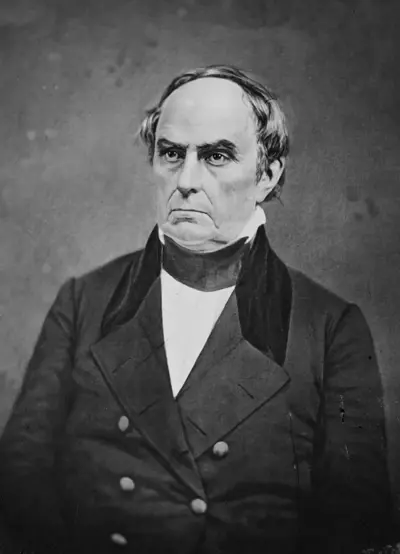
Daniel Webster was an American lawyer and statesman who represented New Hampshire and Massachusetts in the U.S. Congress and served as the U.S. Secretary of State under Presidents William Henry Harrison, John Tyler, and Millard Fillmore. As one of the most prominent American lawyers of the 19th century, he argued over 200 cases before the U.S. Supreme Court between 1814 and his death in 1852. During his life, he was a member of the Federalist Party, the National Republican Party, and the Whig Party.
