Irshad Manji Quotes
I'm asking Muslims in the West a very basic question: Will we remain spiritually infantile, caving to cultural pressures to clam up and conform, or will we mature into full-fledged citizens, defending the very pluralism that allows us to be in this part of the world in the first place? My question for non-Muslims is equally basic: Will you succumb to the intimidation of being called "racists," or will you finally challenge us Muslims to take responsibility for our role in what ails Islam?
Manji, Irshad. The Trouble with Islam Today: A Muslim's Call for Reform in Her Faith. St. Martin's Griffin, 2005.


The major complaints of Muslim fundamentalists then was that “non believers” should never be in government positions of authority over Muslims and that Islamic Law—Sharia—was not the law of the land. The modern and reformist Muslims tried to change the vision of their co-religionists but progress was slow. Over a century later, the same complaints are made by Islamic fundamentalists today and the Muslim reformers are still trying to persuade them that what they want is not desirable.

an old term for Muslims The Muslims were present in every state if India. Jinnah’s concept of nationhood is very Islamic in that Muslims are united even if they be in different states of nations. He was arguing to reserve some states as Muslim states by designation. 7 years later he would insist on a separate homeland. India was partitioned and Pakistan and Bangladesh resulted but at a fearful cost of tens of millions of lives.


She makes the critical point that in America, for the first time in history, Islam could develop “where the freedoms of thought and speech are guaranteed political rights.” The result she believes will be an Islamic Reformation. America and its freedoms has actually fostered the development and creation of many religions. For example, Christian Science, Reform Judaism, Pentecostalism, Mormonism are just a few. Even American Roman Catholicism has evolved some unique characteristics.
Soon after individual inquiry and interpretation was discouraged and then made illegal and punished just as with the Christian Church at the time. Thereafter, the Islamic societies were intellectually closed and deteriorated resembling the Christian state of intellectuality. The Christians began to slowly liberalize and the Protestant Reformation spurred new thinking and Christianity was reinvented by both Catholics and Protestants and Christian intellectual, political, and economic development thrived. Islam has not yet had a reformation but there are modernist Muslims trying. See {623580} .

This is a particularly noteworthy quotation as Muslims are often accused of intolerance and here is a Muslim who argues that it is the responsibility of religious leaders to present religion in a tolerant manner.


Many, if not most, non-Muslim scholars and thinkers very much disagree with Hamid on this point. The great exceptions of Islam are almost 1,000 years in the past. Current Islam, they argue, is not more exceptional than the beliefs of modern Mongolia which dominated most of the known world centuries ago, but has little that deserves special respect in the 21st country beyond the general respect which is owed to all religions and nationalities. With the exception of Turkey, Islamic nations are for the most part, backward, and virtually no other non-Muslim nations try to emulate them in any way.

Essentially, he is advocating a reformation of the Islamic religion, much like that which has taken place in Christianity and Judaism. However, while most Muslims of the world are not extreme fundamentalists, most of the existing clerics (as did their Christian and Jewish counterparts years ago) turn any attempt at reform into blasphemy and sin. Throughout much of the Islamic world, Muslims who argue publicly for reform are at risk for their lives as the existing Muslim clerics generally encourage attacks on reforms or turn a blind eye to efforts to suppress reform.


He was out of office and speaking as an individual. The then President was spewing hate and barbaric fundamentalism which represented the views of the Mullahs who control Iran. (The President has very little power and he can be overridden by the religious authorities whenever those authorities feel that Islam is being compromised.
This problem which was so well described over a century ago in Egypt, still vexes most of the Islamic world.
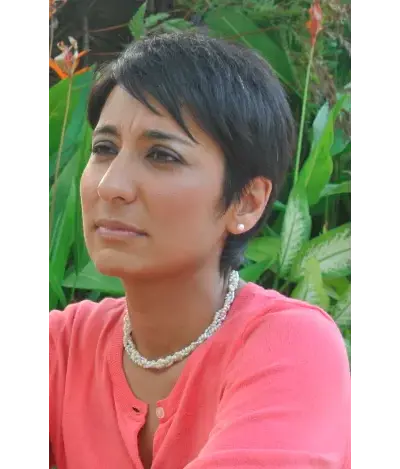
Irshad Manji (born 1968) is a Ugandan-born Canadian educator. She is the author of The Trouble with Islam Today (2004) and Allah, Liberty and Love (2011), both of which have been banned in several Muslim countries. She also produced a PBS documentary in the America at a Crossroads series, titled Faith Without Fear, which was nominated for an Emmy Award in 2008. A former journalist and television presenter, Manji is an advocate of a reformist interpretation of Islam and a critic of literalist interpretations of the Qur'an.
