Jay Garner Quotes
I’ll make it easy on you Jerry. I’m going home.
After the military victory in Iraq, Garner was in charge of reconstruction and getting Iraqi civil servants paid. Then the President appointed Paul Bremer as the do facto Governor of Iraq. No sooner did Bremer arrive and take charge than he alienated most Iraqi and even American officials including Garner. Bremer wanted direct control of all civilian and military staff including Garner’s staff. Garner did go home, and Bremer totally controlled a difficult situation in post-war nation building of Iraq. By the end of Bremer’s tenure, the situation had deteriorated almost beyond repair.
Jay Garner, Army General & Iraq Reconstruction Director, Statement to American Occupation Administrator of Iraq, Jerry Bremer, Interview with Brian Lamb, C-SPAN Q&A, December 10, 2006
Sourced by: Eigen's Political and Historical Quotations

Johnson had no real role as Vice President in the JFK administration. He had no power as he understood it also. He urged his staff to hook up with another politician who had a brighter future. Then JFK was assassinated and Johnson was suddenly the post powerful person in the world.


As Secretary of State, Powell was going to address the UN Security Council on the 5th and he was coordinating his speech with the other agencies of the government. His criterion was that he only wanted to make accusations that were backed up by incontrovertible evidence. However, VP Richard Cheney and his aide, Scooter Libby, kept inserting an accusation that Iraq was involved with and supported Al Qaeda. This was one of the many speculations that those who wanted to justify attacking Iraq kept using as Domestic propaganda. When Powell asked for proof or intelligence reports and none could be provided, he removed the accusation from the speech explaining why. However, at the last minute, Cheney and his staff put the accusation back in, and that triggered the quotation. Unfortunately, Powell was so busy fending off totally absurd accusations, that he accepted the CIA assurances {79468} that Iraq was developing nuclear weapons that were about to be operationalized and never heard from those who questioned the credibility of the sources for the basic accusation. Powell had great trust among the diplomats of the world then gave the United States version to the Security Council and justified our coming invasion of Iraq. But the intelligence report, despite the assurances of the CIA and the Vice President, was false and Iraq not only was not close to a nuclear weapon but he had no program at all at that time to try and develop one. Powell resigned and his credibility about the world was ruined as he was then seen as just another lying politician.

In one of the most famous rebuffs of a politician to his constituents, the congressman sent the following message home to his constituents after receiving instructions from them which he did not care for. He went to Texas where he died defending the Alamo.

After being surrounded by the Germans for seven days at what would later be called the Battle of the Bulge, a German officer notified the Americans that they would accept their surrender. McAuliffe’s one word response summed up the resolve of the Americans who were surrounded. The Americans managed to hold the line and defeat the German’s last major offensive of World War II.


Critics of his position observe that the Islamic fundamentalists will never allow girls to go to school even if they were built and they might blow up any school that might be constructed if the allies did not have enough troops in Iraq to protect them and suppress the terrorists. When the Taliban fundamentalists controlled Afghanistan before the coalition drove them out, neither little girls not big girls could acquire education and women were not even allowed to work.
Powell’s views and advice to the President regarding Iraq were diametrically opposite that of Vice President Cheney, Secretary of Defense Rumsfeld and National Security Advisor Condy Rice. The President sadly rejected Powell’s advice. He was right, but he was also a trained professional staff man who maintains his loyalty and does not quit just because his advice is not taken. Many believe that if he had resigned in the political rather than military tradition, the nation might have been spared much of the loss and embarrassment the Iraq invasion and occupation cost us.
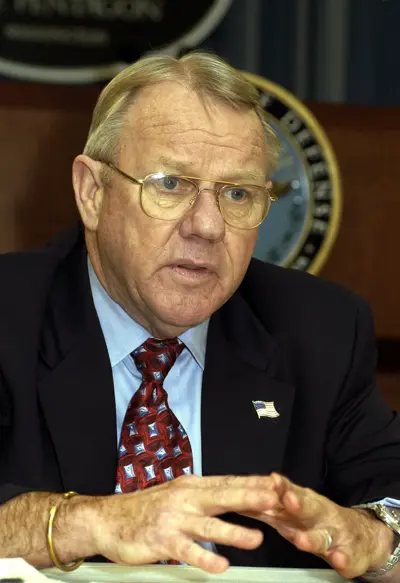
Jay Montgomery Garner is a retired United States Army lieutenant general who in 2003 was appointed as Director of the Office for Reconstruction and Humanitarian Assistance for Iraq following the 2003 invasion of Iraq but was soon replaced by Ambassador Paul Bremer and the ambassador's successor organization to ORHA, the Coalition Provisional Authority (CPA).
