Jack Germond Quotes
If you hold George W. Bush up to the light, he won't cast a shadow.
Jack Germond, 1928-2013, Political Columnist, 1979
Sourced by: Eigen's Political and Historical Quotations


Although there were many irregularities in the 2000 election and many thought that Bush was not the rightful winner, Nadar’s statement is ironic. He entered the race as the Green Party Nominee and siphoned off many more votes from Gore than from Bush. In Florida, the pivotal state, Gore lost by less than 600 votes and but for Nader, Gore would have won and become President. Then for him to later blame Bush’s maneuvers for Gore’s defeat, ignoring his own determinative role struck most observers as the height of selective analysis.


The Senator was blaming President Clinton for not stopping the attack on the U. S. Cole as he knew that there were hostile Islamic extremists who were known to have threatened to attack American assets wherever they were. His view was that given that President Clinton should have acted overtly and/or covertly to prevent the attack. This failure for him was an impeachable offence. He argued that George W. Bush was assuming the Presidency and this laxness and incompetence that lead to the death of 17 American sailors would end. And then came 9-11 with the same level of general information and some even more specific information and 3000 Americans were killed. However, unlike Lott, almost no one blamed President Bush’s lack of leadership for the attack on the Pentagon and the World Trade Center. Lott seemed to forget his standard of presidential performance and did not criticize or urge the impeachment of the President of his own party.
The attack on the World Trade Towers and our military reaction to that could not fairly be blamed on Bush. However, the Iraq War was certainly a policy choice he made. And he also made the decision to cut taxes (mostly for the rich) on the assumption that this would stimulate the economy and produce even more taxes. It did not. And also on Bush’s policy responsibility was his decision not to raise taxes to pay for a war. This had never been done in American history. And Bush was fighting two wars. In addition when he took office Bill Clinton had balanced the budget and left a substantial surplus. Instead of using the surplus to pay for his other policy decisions, he spent it.
Bush, himself a born-again Christian, made religion in general and fundamentalist Christian values in particular, a major driver of policy making in his administration, subjugating science, medicine, research and social policy to the prevailing views of the evangelical and other fundamentalist Christians. He also claimed that God spoke though him as President. See {589627}.


Bush had been allowed to join the Texas Air National Guard which meant that he did not have to serve in combat in Vietnam the way most other men his age did. However, there were no records of his having reported for duty during several months when he was to be in service. Bush claimed that he was on duty and there was no action taken against him by the then authorities which detractors attribute to his father’s high position and supporters refer to as evidence of the fact that he did nothing wrong. He had been arrested for drunk driving, and the WMD dispute has ever since raged of whether he had been honestly misled by bad intelligence. Bush was not a functional illiterate but had been a college graduate and had completed graduate school studies. He was a poor public speaker and was not an intellectually curious man and did not read much, but this was a huge exaggeration.

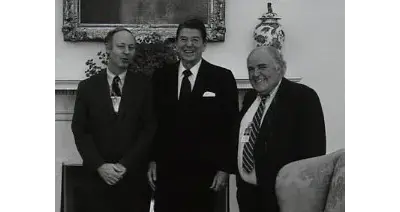
John Worthen Germond, known as Jack Germond, was an American journalist, author, and pundit. His journalistic career spanned over 50 years; Germond wrote for the Washington Star and The Baltimore Sun. Together with Jules Witcover, Germond co-wrote "Politics Today", a five-day-a-week syndicated column, for almost a quarter-century.
