Ethelfrid Quotes
If then they cry to their God against us, in truth, though they do not bear arms, yet they fight against us, because they assail us with their curses.
He ordered his troops to attack the clerics first, and then they moved against the soldiers. Whenever there have been military conflicts with theocracies or cultures where religious leaders had a great deal of control or influence, the dilemma has always been whether to exempt the clerics from military attack. In modern times this has been a central problem in the War on Terror, the Iraq War, and the Israeli-Palestinian conflict. In King Ethelfrid’s view “assailing us with their curses” is sufficient to make them a combatant and further, they should be the first military target because they are motivating the regular troops.
Ethelfrid, Late 6th Century, King of Northumbria [England], Statement to his military commanders regarding a large contingent of monks who had accompanied the enemy army aligned against them, ~605
Sourced by: Eigen's Political and Historical Quotations

In the early stages of Islam, Muhammad had hoped to convert the Jews and others on the Arabian Peninsula. When they refused to be converted, he warred against them usually killing the men, and taking the women and children as slaves. The result was that non-believing tribes were “cleansed” from the Arabian Peninsula. The Muslims at the time preferred children as slaves. For then they could convert the children against their will. Adults in Islam must accept Islam in order to convert. Children are regarded as having no such maturity of decision making and therefore opposition to conversion may be ignored and they may be forced. Critics of Islam and those who argue that Islam is at odds with all other religions point to this quotation. They claim that it is the only religion whose founder and fundamental scriptures demand war against others for no other reason than that they believe in a different religion. The Catholic Church during the Crusades and the Inquisition had a similar philosophy as did Christian missionaries colonizing Africa later. One difference is that most Christians today repudiate the doctrine as against the true spirit and teachings of Christ and view it as historical error, while very few modern Muslims repudiate this quotation of the Prophet.

The Papacy was at one of it’s lowest points. Two men, Clement and Urban, both claimed the Papacy and each had raised an army to fight the other. Each was promising indulgences to those who would fight, and in a modality similar to the Muslim terrorists of the 21st century, the soldiers were promised ascendancy to Heaven if they fell in battle for such a holy cause. The armies of the popes marched under the cross as their banner, and Wycliffe found that obscene and actually wrote a treatise saying so. See {618087}.

Burke did not mean that it was a war between Protestants and Catholics. In his time religious war was considered the most terrible of wars because there were virtually non-negotiable principles involved and the passions were so great. The emotional fervor of the French after the French Revolution was extreme in that they were bringing freedom to Europe.


See {613496} for the origin of the “thrashing a cannibal” phrase.


Marquis de Seignelay. At the time, a perfectly acceptable justification for war on a people was that they were interfering in the plan to convert the area to one particular religion, in this case, Catholicism.

The phrase was picked up by the press, and then became the title to a patriotic song of World War II.

See {586041} for a Koranic quotation that urges world domination by Islam. In this quotation, The Prophet was talking to his followers at a time when Islam was not even a dominant religion in Arabia. And war was the way in which tribes, groups, and religions and sects, established themselves and grew. Although there are other Koranic passages which tell the faithful that people can only legitimately come to Islam through individual commitment and willingly, this passage not only seems to contradict that but also reflects a desire to punish and disgrace “non-believing” groups. This vengeance motif is also contradictory to much else of the Koran which generally preaches love, forgiveness, and understanding. However, there are contradictions and intellectual inconsistencies within the Koran just as there are within the Old and New Testaments.


This would be like an American President firing the congressional chaplains. However this is only one small, but telling, example of Atatuk’s secularization of the nation which had a great deal to do with Turkey becoming a modern great power—by far the strongest and most developed of the Islamic world.

There was deep hostility and suspicion between Germany and England for several years before WWI. See {642066}.


If some Islamic cleric declares a war or dispute to be an attack on Islam, the penalty is indeed severe for those Muslims who do not join the fight. In some Islamic lands, unbelievers are put to death. Note that the children become the Islamic society’s hostages for the behavior of the father.


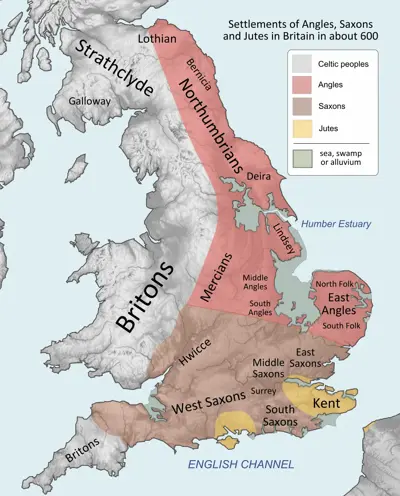
Æthelfrith (died c. 616) was King of Bernicia from c. 593 until his death. Around 604 he became the first Bernician king to also rule the neighboring land of Deira, giving him an important place in the development of the later kingdom of Northumbria. He was especially notable for his successes against the Britons and his victory over the Gaels of Dál Riata. Although he was defeated and killed in battle and replaced by a dynastic rival, his line was eventually restored to power in the 630s.
