John C. Calhoun Quotes
I will not attempt to show that it would be a great evil to increase the patronage of the Executive. It is already enormously great, as every man of every party must acknowledge, if he would candidly express his sentiments.
Calhoun, John C. The Works of John C. Calhoun. Edited by Richard K. Crallé, vol. 2, D. Appleton and Company, 1853.


In an irony, the first President limited by a term limit amendment pushed by Republicans remembering FDR turned out to be fellow Republican Dwight D. Eisenhower.

Referring to President Bush's winning a roll-call vote in the House on lowering the capital gains tax:


Secretary of State William H. For a similar assessment of Seward see Morton S. Wilkinson.


Taken from the Nixon Tapes of June 14, 1971. This quotation illustrates the mental set of the Nixon White House where the President must be seen as infallible and obeyed without much questioning. After Nixon, that view did not surface again in American politics until the George W. Bush Presidency. The Federal Courts were not very sympathetic to the Haldeman assertion and allowed the publication.


Roosevelt was responding to proposals that the Governor have the power to remove state and local officials for corrupt acts earlier in their career. With a number of big city political machines nominating and electing officials who had previously been convicted of corruption, there was a movement to give this authority to the Governor. In Boston, Mayor Curley was elected while he was in jail serving time for Corruption as an example. Still for FDR and many others, that was the prerogative of the electorate, and must not be usurped by a governor. In states where corruption was totally rampant, like Texas, the reformers passed laws making convicted criminals ineligible to serve in public office.

The commercial special interests, together with the banks had become a very dominant force in society just as before the Great Depression in 1929 and the Great Recession in 2008.

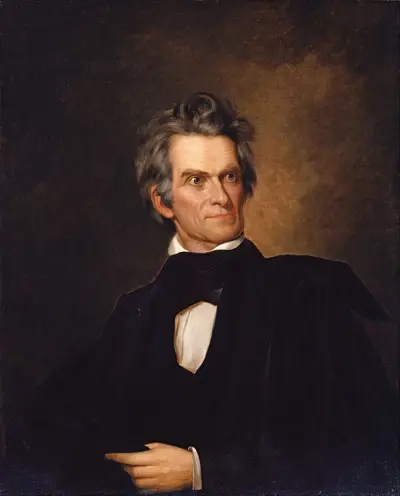
John Caldwell Calhoun was an American politician and political theorist from South Carolina who held many important positions including being the seventh vice president of the United States from 1825 to 1832, while adamantly defending slavery and protecting the interests of the white South when its residents were outnumbered by Northerners. He began his political career as a nationalist, modernizer, and proponent of a strong national government and protective tariffs. In the late 1820s, his views changed radically, and he became a leading proponent of states' rights, limited government, nullification, and opposition to high tariffs. He saw Northern acceptance of those policies as a condition of the South remaining in the Union. His beliefs and warnings heavily influenced the South's secession from the Union in 1860–1861.
