Jack Adams Quotes
I was assigned to the heavy cruiser Chicago.
Adams, Jack. "World War II: Yeoman First Class Jack Adams Recalls the Battle of the Coral Sea." World War II, Primedia History Group, May 2002.

Most Americans do not realize that our naval forces were disbanded after the Revolution and even the Constitution did not require a navy. We had some Federal revenue cutters to interdict smugglers but no warships and no permanent sailors or officers. The Barbary Pirates had an incredible extortion racket going in the Mediterranean. If nations would pay them an annual sum each year, they would not attack and seize merchant ships of that country and sell the ships and goods while holding the sailors for ransom. See {640850},86703,{640846} & {640848}

Gingrich, who avoided serving in the military throughout his life, was frequently opining on military matters, tactics and strategy in his speeches, media appearances and many writings. Generally, he was a Chicken Hawk {625110} urging military action and war although he had personally never experienced it. He spent much time in military meetings and conferences, and thought that he had developed some expertise from this and his extensive reading.


He became one of the great heroes of the American navy and this statement is taught to every American sailor. Actually, although a very good Captain, in the battle with the Shannon, he made a number of mistakes which was unusual for him, but the Shannon won the battle. The American sailors did not give up the ship, but they were overcome with one of the highest casualty rates of any sea battle of the time. Had Lawrence lived—he dies of infection from his wounds—he probably would have faced a board of inquiry or a court martial, but his death turned him into an American hero. See {625129}. Commodore Perry, a friend of Lawrence, had “Don’t Give Up The Ship” sewn on to his battle flag, and the motto has been part of the United States Navy ever since.

1st Earl of Oxford. Churchill was then First Lord of the Admiralty, and an enthusiastic proponent of entering the First World War.

The Germans did not believe the British would send land troops. See {642105}.

Dreadnoughts were huge battleships. Britain had the dominant navy of the world and controlled the seas. A European war would be a land war where a navy would be of little use. Hence, Britain would not want to get involved in such a war where she could not use her greatest military strength. He was wrong about this and so much else. Britain entered WWI when Germany invaded Belgium fulfilling her treaty obligations. The Germans intelligence operators and analysts were well aware of the treaty obligations, but had little understanding of English culture and tradition. The German aggression against a small power like Belgium was morally offensive to many in Great Britain, and Britain had a tradition of fighting for moral principles. The Germans would never militarily disadvantage themselves for the sake of a treaty obligation to a small nation, and they did not believe that the British would be so different and fulfill their treaty obligations even though their strongest military asset—their navy would not be very helpful.


In the first year of WWI, the British Fleet kept the German Fleet bottled up in port. As a result, the British had a very successful sea embargo against the Germans who rarely challenged the British fleet even though they had some major, powerful, capital ships. See {642234}. Meanwhile, the German ships were in no position to harass much less destroy Allied (French, Russian or English) shipping.


Roosevelt was then the Assistant Navy Secretary. However, the Secretary was on vacation and Roosevelt as Acting Secretary anticipated the Spanish American War. TR had also ordered large amounts of supplies and ammunition and when the President and Congress were faced with the possibility of war with Spain, the Navy was fully ready for war enabling the Declaration.
One of the interesting things about Roosevelt is that he thoroughly enjoyed both the politics and the administrative parts of his different positions.

The sloop Margaretta was escorting 2 small merchant vessels came into the port of Machias, Massachusetts to purchase some lumber and firewood. However the commanding officer of Margaretta did not like the terms of the negotiations and threatened the town. An aroused and angry group of patriots then boarded and attacked the two merchant ships. The commander of Margaretta then maneuvered out of the port having lost the two small ships. But the Patriots were angry with the commander of the sloop and being excellent seamen who knew the local waters, used one of the merchant ships and a small local vessel to chase down the Naval sloop. They then boarded and captured Margaretta and fatally wounded the commander, James Moore. While Lexington was the first land victory for the patriots, this was the first sea victory and the Margaretta was the first British warship that was captured by the Patriots.
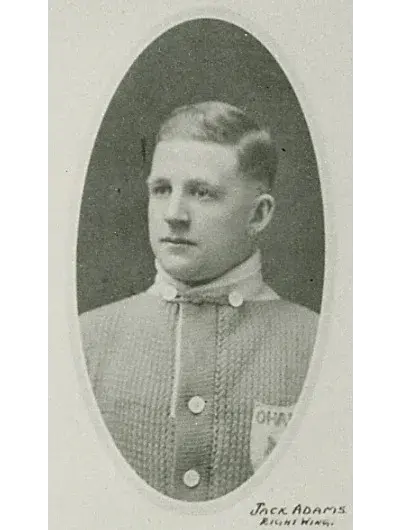
John James "Jack" Adams was a Canadian professional ice hockey player, coach and general manager in the National Hockey League and Pacific Coast Hockey Association. He was a Hall of Fame player during a 10-year professional career with Toronto, Vancouver and Ottawa.
