Winston Churchill Quotes
I shall endeavor to marshal British opinion against a course of action which would bring in my opinion the greatest evils upon the people of India, upon the people of Great Britain and upon the British Empire itself.
Churchill, Winston S. Churchill by Himself: The Definitive Collection of Quotations. Edited by Richard M. Langworth, PublicAffairs, 2008, p. 172.

In contrast to Queen Victoria and the Conservative Government before him, Gladstone opposed most colonial expansionism. However, in a policy analysis that in later years would come to be called “the Domino Theory,” Gladstone felt compelled to put down the revolt.


He persuaded many other rulers to join the Indian Union when India became Independent.

India was soon to be granted Independence by the Labor Government, much to the chagrin of Winston Churchill and other Conservative politicians who wanted to diminish the British Empire as little as possible. Jinnah, not wanting the majority Muslim areas of India to be part of a Hindu majority India, came up with this clever alternative. Britain would grant independence only to the Hindu parts of India and the remainder—Pakistan—would remain in the Empire as an autonomous colony. Many of the British politicians believed that that would be a constant friction in the Empire as many of the "Pakistanis" would then want their own independence and use the terror tactics to fight for it. Besides, the Conservatives did not have enough votes to stop Independence to all of India. Jinnah's efforts however were enough to lengthen the debate in the British Parliament thereby delaying independence for all of India and angering the pro-independence leaders throughout India. Jinnah, by then an autocrat, did this in secret, behind the backs of his own Muslim colleagues, many of whom had Independence as their highest priority.


In one of his reports, the term was used and appears to be the earliest use of the phrase that can be found. Dee was perhaps the original Agent 007—see {614640}.


The British had, after earlier defeats, finally had great military success in India/Afghanistan on the one hand and China on the other. Note that the objects of the military expeditions were always twofold: First to expand trade and trading opportunities for England. Second to retrieve “honor” that had been lost by earlier military defeats.


He was addressing the Conservatives of Ulster, the Northern Ireland province that was the center of the Orangemen movement of Irish Protestants who were fighting to retain 'Protestant Ascendency' -- which was the social, political and cultural domination of the Protestants (the minority) over the Catholics (the majority). This was best achieved by keeping Ireland a part of Great Britain as opposed to having Ireland as a separate, independent country.

The revolutionary acts from some of the more radical colonists but the colonial power structure was trying to negotiate for changes from the taxation and rights-impinging laws that Parliament had passed. Within a year the Continental Congress would take a more revolutionary position when this petition yielded no betterment-- {636864} and {636958}.


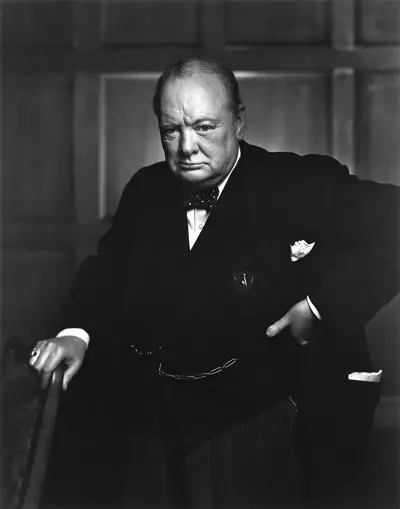
Sir Winston Leonard Spencer Churchill, KG, OM, CH, TD, DL, FRS, RA was the Prime Minister of the United Kingdom from 1940 to 1945, during the Second World War, and again from 1951 to 1955. Apart from two years between 1922 and 1924, Churchill was a Member of Parliament (MP) from 1900 to 1964 and represented a total of five constituencies. Ideologically an economic liberal and imperialist, he was for most of his career a member of the Conservative Party, as leader from 1940 to 1955. He was a member of the Liberal Party from 1904 to 1924. Churchill was also well known for his military career and as a historian, painter and writer, and among his many awards was the Nobel Prize in Literature.
