Ezra Stiles Quotes
I remark that Providence seems to make every Thing to work for Mortification to the Jews & to prevent their incorporating into any Nation; that thus they may continue a distinct people.
See {619709}. Ever since the Jews were ejected from their nation by the Romans, there have been some Jews and non-Jews who believed that the refusal of other nations to allow Jews citizenship inhibited their assimilation and was God’s way of maintaining the Jews as a distinct people so that they may fulfill Biblical prophesy and return to the Land of Israel. Stiles was a leading historian of his day and specialized in ancient Biblical history. Most people however, and most Jews, do not hold with this theory.
Ezra Stiles, 1727-1795, President, Yale University, Criticism of the Rhode Island Superior Court Decision preventing Jews from holding office or voting, 1962
Sourced by: Eigen's Political and Historical Quotations

Lopez and Elizer were Jews who had escaped the persecution in Portugal to come to America. They and other non-Christians could live and work in Rhode Island but could not vote or hold public office by a previous decision of the Rhode Island Assembly. See {619707}.The Jews had petitioned for their civil rights.
Lopez had come from Portugal and had been living in Rhode Island for 9 years and was active in shipping, whaling and candle making. He, and another Jew, Issac Elizer, petitioned the Rhode Island Superior Court for naturalization and citizenship rights. The court turned them down and they appealed to the Rhode Island Assembly—then not only the legislature but the highest court in the colony. The assembly came up with a compromise. The Jews were allowed to continue to live and work in Rhode Island but they could not hold public office or vote. They told the Superior Court to reconsider the case however as Lopez and Elizer were model citizens—but for religion just the kind the colony wanted. This case and many others were known to the founding fathers who were determined to put a stop to the practice of conditioning voting and office holding rights on adhering to the particular sect of the majority of the colony. Lopez and Elizer then appealed again to the Superior Court.


All German Jewish Citizens were immediately disenfranchised including decorated military veterans.


These kinds of inflammatory sermons are delivered with the approval of the king and royal family who crack down on any cleric who preaches what they do not approve of.

The Nazis had started vicious persecution of Jews in Germany. In the early days of irrational anti-Semitism and Nazism he preached against the irrational Nazi propaganda – See {638920}. However, when it became clear that the Nazis had the upper hand, he publicly recognized the Nazi government as legitimate, required Catholic clergy to remain loyal to the Nazi government, and maintained bridges between fascism and the Church He then became silent on the terrible, inhuman, un-Christian treatment of the Jews concentrating his efforts on negotiating the best for the Catholics that he could get. See {639129}.

While most American leaders in 1776 advocated separation of church and state, others did not. There probably has been no better statement for religion in government than this one. Essentially, this view has been held by orthodox Christians, Jews, Muslims and has been at the heart of every theocracy such as Iran.

According to Bauer and his anti-Semitic followers, the problem with the Jews was Judaism

Saint Benedicta was born and brought up as a Jew and converted to Catholicism. She and a few other leading German Catholics spoke out forcefully against Nazi crimes and immoralities. She was one of the few German Catholics who wanted the Pope to act more forcefully in Germany. The most controversial aspect of the Pontificate of Pius XI was his relative silence and failure to use the powers of the church and excommunication to condemn and control the Nazi rise to power and their, aggression, discrimination, and atrocities including mass murders. The Pope did occasionally speak out condemning the worst of the German Nazi outrages to morality, but he did not do so very vigorously or order the German Cardinals and other bishops to do so. Supporters of Pius XI point out that the entire Catholic Church in Germany was in peril. The Nazis might have shut down their churches, jailed or murdered priests and seize church property. Many of the German Catholics, including the clergy, were Nazi party members or supporters, and he feared a political schism of German Catholics as well. And Italy, surrounding the Vatican was then under the control of the Italian Fascists who were allies of the Nazis, The Vatican itself and its staff were themselves vulnerable and could have been easily occupied. Apologists for Pius XI observe that the entire Church and its leadership could have been wiped out had they ignored the practicality that the Fascists were in control and would tolerate the Church just so far. Saint Teresa and other Catholics who were outspoken, along with the few Protestant Lutheran Clerics who opposed the Nazis, were indeed arrested and Saint Teresa was finally murdered at the Auschwitz concentration camp. Even that did not galvanize Pope Pius XI to assertive anti Nazi action. The records of the Vatican for that period have not been opened for public study so it is not known for sure that the Pope even saw Saint Teresa’s letter or it was intercepted by the strong pro Nazi faction in the Vatican. That year, Pius signed a Concordat (agreement) with the Nazi Government which many in the Vatican naively believed would control and limit the worst of the Nazi actions. But by 1937, Pius condemned the “violations” of the Concordat and Nazi anti-Semitism as well (encyclical written in German, Mit brennender Sorge (With Burning Anxiety). His critics observe that he went no further, even with the Catholic Nazi clerics and other Catholics. The Carmelite order tried to protect Saint Teresa who was then just a non and leading Catholic intellectual (she had a PhD in philosophy) by sending her to a Carmelite facility in Holland. But the Germans overran the Netherlands, arrested her and sent her to Auschwitz where she was martyred. She was beatified by Pope John Paul II in 1987.


At the time, most of the world did not believe that the Germans were literally serious in their anti-Semitic rhetoric. It was assumed that this kind of talk was just populist rhetoric to get votes and maintain power. The main lesson of Nazi Germany is when leaders of a country, threaten the existence of another country or a people, they must be taken seriously, and not just as politicians being populists and pandering to an ignorant, biased public.
Toleration is a relative term. The Muslim Moors made Christians (and Jews) pay a special tax. At times they were forced to wear special clothing so that they could be readily identified. And they could not build churches larger or taller than the smallest mosque in the community. At times, their occupations were restricted but at other times Christians and Jews were appointed to the highest positions like Vizier. The Inquisition, in contrast, forced all Muslims (and Jews) to leave the country without any of their property or money or be tortured and killed—usually by burning at the stake unless of course that they converted to Christianity.


There was freedom of religion for Protestants in early New Jersey. Note that Catholics and Jews were not allowed to hold office. This constitution was in force until 1844 when the prohibition was repealed by new constitution. Under the original constitution, men were convicted for blasphemy. See {621063} .

O’Connell also fought for Jewish equality as well as Catholic Equality.


These were the most terrible and restrictive laws against Jews who would be hunted down and forced to accept Christianity. The Visigothic laws were a combination of Visigothic tradition and the codification by Catholic Clerics. Many scholars have traced the terrible policies and practices against Jews by the Spanish throne and the Inquisition 500 years later to these earlier Spanish Visigoths and their formal legal structure. This is the most formalized and sophisticated compendium of laws of the so-called “barbaric peoples” of Europe. The compilation was in many ways a documentation of the traditional laws of the Visigoths that had evolved over hundreds of years.


Louisiana was then a possession of France

Porush was one of the Haradi--ultra-orthodox Jews. In the land of the Jewish people, he argued against religious freedom for Jews unless they were Orthodox Jews, while ironically, the majority of Jews in the world and even in Israel followed the Conservative or Reform branches of Judaism or were secular. At the time the Orthodox Jewish movement was the only one that was recognized officially by the government. Porush and some of the more fanatical Haradi were determined to keep the Conservative and Reform Jewish branches unrecognized and unsupported by the government. (Israel does not have separation of church and state and economically supports the Orthodox Jewish establishment but not the other majority branches of Judaism.) The "Women of the Wall" is one of the major groups in Israel advocating equal government treatment for all citizens o0f Israel. Orthodox Judaism, like many other orthodox religions are very sexist and women were actually banned from praying at the holiest of Jewish places, the Western or Wailing Wall. Women of the Wall had won a major decision of the Israeli Supreme court that women could not be denied the right to pray at the Wall. The orthodox rabbis who the government allowed to control access to the Wall, set aside a small area for women at the "Dung Gate" where the garbage was carried out. Women of the Wall were back in court and this prompted Porush's outburst. He was cebsured by the Ethics Committee of the Israeli Knesset (Parliament).
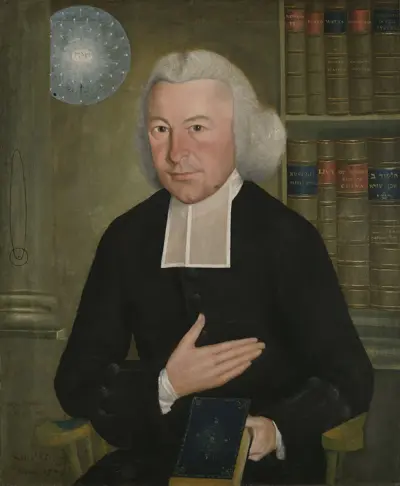
- Born: December 10, 1727
- Died: May 12, 1795
- Nationality: American
- Profession: Clergyman
Ezra Stiles was an American academic and educator, Congregationalist minister, theologian and author. He was seventh president of Yale College (1778–1795), and one of the founders of Brown University.
