Horace Greeley Quotes
I recognize most thoroughly the right of woman to choose her own sphere of activity and usefulness, and to evoke its proper limitations. If she sees fit to navigate vessels, print newspapers, frame laws, select rulers—any or all of these—I know of no principle that justifies man in interposing any impediment to her doing so.
Horace Greeley, 1811-1872, Newspaper Editor & Candidate for the Liberal Republican Presidential nomination (defeated by Ulysses S. Grant), Quoted in E. C. Stanton, S.B. Anthony and M. J. Gage, The History of Woman Suffrage
Sourced by: Eigen's Political and Historical Quotations

Despite this pronouncement which kept Caliphs from being female, modern Islamic states (Pakistan, Indonesia) have had female Presidents.


Nixon did however make some minor appointments of females. One irony of this statement is of all the Presidents in American history, he was probably the most erratic and emotional.

SNCC had been formed to promote equality, but race and class were the issues, not gender. Many of the women left SNCC and proceeded separately to start a women’s movement.

Given the time, this was an amazing demand. Fuller preceded all the more famous American feminists and was an inspiration to them.

The CAA was the Civil Aeronautics Administration, the forerunner to the Federal Aviation Administration (FAA).


This Biblical passage has been frequently used to justify discrimination against women.


Jorge Mario Bergoglio


This was her last public speech. In general, when women would speak in public, they would be ridiculed and castigated by the press which reflected a macho cultural view that women should be seen and not heard,

Jinnah was a modern Islamic reformer as this quotation demonstrates. Pakistan is not as backward as most of the Arab Islamic countries on the role of women. There are many Pakistani businesswomen and professionals. Pakistan has even had a female president. However, the fundamentalist Islamic forces that dominate the culture constantly preach and advocate the literal interpretation and following of Sharia which calls for a traditional, subservient traditional role for women; “honor killings” are common; “a rapist cannot be convicted on a female victims testimony; there are calls for the killing of adulteresses and other primitive throwbacks. Jinnah’s vision has not come to pass yet.
She was the First Lady, who in many ways was also one of the nation’s leading feminists. Betty Ford, Barbara Bush, and Hillary Clinton were also First Ladies who supported key feminist position but ER was 30 years ahead of them—a time when conservatives and sexists viewed her as a dangerous radical. For example, see {585211}.

He gave a litany of ills that have occurred when women had been educated. He did not provide any of the counter examples.
She had been appointed by President Truman to be the US Delegate to the First United Nations sessions where she had a major role in forming the organization to meet the needs of the United States (The veto in the Security Council for example). John Foster Dulles, our Secretary of State was publically totally against having any woman in that position and later would come to regard Mrs. Roosevelt as a great danger. See {585211} . Yet he admitted that she did a good job with the UN. She was 62 at the time, and while we do not consider that as very old any longer, there were very few people who would be active in politics at that age and certainly no women. She stayed active however until her death more than a decade later.
At the time and for the next decade she was one of the few world leaders who made women’s equality and rights a major priority. But slowly American and European women and many men began to give higher priority to using foreign policy and foreign aid. Then women from Asia and Africa began to take up the issue and in the early 21st century even some women in the Islamic nations began to fight for women’s rights. Mrs. Roosevelt. However, was the first modern major and high visibility politician to make women’s rights a major international and national issue.


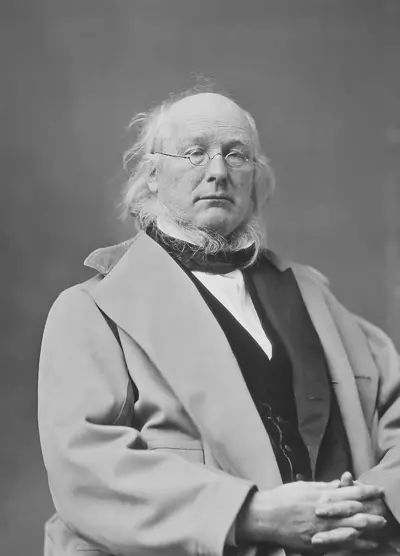
Horace Greeley was an American newspaper editor and publisher who was the founder and editor of the New-York Tribune. Long active in politics, he served briefly as a congressman from New York, and was the unsuccessful candidate of the new Liberal Republican Party in the 1872 presidential election against incumbent President Ulysses S. Grant, who won by a landslide.
