Samuel Johnson Quotes
I have adopted the Roman sentiment, that it is more honorable to save a citizen than to kill an enemy.
Johnson, Samuel. The Rambler, No. 114. J. Payne and J. Bouquet, 1751.


He had been mortally wounded in battle and asked the Duc de Bourbon to prop him up against a tree facing the enemy. Then enemy army was French also but abandoned the cause of the French King to fight with the more powerful Holy Roman Emperor, Charles V. He was only going to die, but the enemy would remain traitors for ever. This was typical of the code of the Knights of which he is sometimes referred to as the Last of the Knights.


Trumbo was morally opposed to war. He also refused to name Hollywood communists to Congressional Committees during the Red Scare. He was then blacklisted from his occupation, screen writing.


“Volk” loosely translated means “the people.” However it carries the connotation of a unity that “the people” does not.


The American Army had just liberated Bellau Wood, but had lost almost 8,000 men.


He was leading the Gordon Highlanders of the British Army against the Boers during the Boer War. He was seriously wounded and could not go on himself with a charge he had ordered, However, waifing his sword he made this famous qutation. Particualrly noteorthy is the derrogatory terms which he used to describe the enemy--the Boers of South Africa. In many wars and cultures, one or more of the combatants, in order to overcome the avarage soldier's reluctance to kill an enemy, characterizes them as less than human. In this case, vermin, who were to be exterminated. There were two predominant groups of whites who came to South Africa, the English who were generally well-educated and were interested in trading with the exhisting inhabitants and investing in businesses using mostly native labot and the Boers. The latter were of Dutch and German origin, poor farmers with little or no land in the home country and little education. Their interest was to create a nation where they could own land to farm. And the lest expensive way for them to increase their farmland was to sieze it from the native Blacks and who were the major forces behind the racial discrimination which became apartheid. The British contolled the government and sought stability and as in most of the British Empire, they wanted English law to prevail including the rights of the Black natives. The Boers had left Europe for good and would thrive or not in Southern Africa. Proportiopnately, the English might have a career in South Africa or serve there for a few years. They were Englishmen in a foreign country. The Boers saw themselves as citizens of Southern Africa who were fighting the native Blacks for control of the land. The English legal system would not allow any of the land seizures and political discrimination that the Boers saw as existential for their survival in Africa. Soon, the Boers took more and more of the law into their own hands and saw English rule and dmination as inimical to their interests in Africa and they tried to create their own independent states in Southern Africa. That was the essense of the Boer Wars. Dick-Cunyngham was awarded the Victoria Cross, the highest military decoration of Great Britain, for his exploits in the Afghan War.


A veteran who had lost a leg in battle applied for a small postmastership. Jackson was told that the veteran had not voted for him:


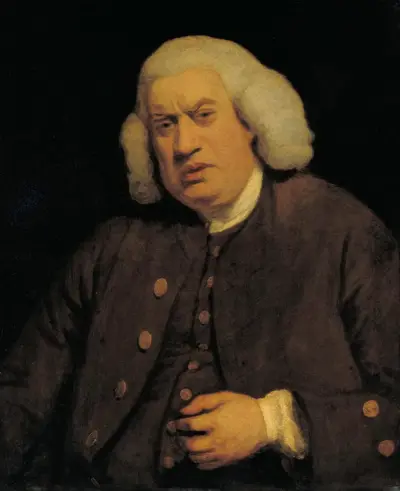
Samuel Johnson, often referred to as Dr Johnson, was an English writer who made lasting contributions to English literature as a poet, playwright, essayist, moralist, literary critic, biographer, editor, and lexicographer. Religiously, he was a devout Anglican, and politically a committed Tory. The Oxford Dictionary of National Biography describes Johnson as "arguably the most distinguished man of letters in English history". He is the subject of James Boswell's The Life of Samuel Johnson, described by Walter Jackson Bate as "the most famous single work of biographical art in the whole of literature".
