Brooke Astor Quotes
I had a job; I was, during the war, a nurse, a 'Gray Lady.' We wore a veil and a gray dress.
Astor, Brooke. Footprints. Doubleday, 1980.


This is an interesting historical quotation because it shows how easily the United States commandeered private property during World War II. All it took was a letter from the Secretary of War. This particular quotation and letter had further historical significance. The school was acquired as the first facility for the Manhattan Project in Los Alamos. This was where the atomic bomb was built.

“Removal” was interpreted by some as killing and by others as jailing. Complaining about wartime suffering or hardship was a crime in militaristic Japan.

DPs were “displaced persons” -- the euphemism for people who were no longer welcome in their country of birth. Congress, made up mostly of immigrants or the children of immigrants who were poor and downtrodden, were not enthusiastic about the United States absorbing many of the world’s DPs resulting from WWII.


After Japan attacked Pearl Harbor, we declared war on Japan. Germany then declared war on the United States, and America was in the fight. But the earlier policy had been to provide weapons, food, and supplies.

Prior to this order, some German submarines had assisted the survivors of torpedoed ships. None did after and some actually machine gunned survivors in the water. One aspect of the quotation that is particularly interesting was the Admiral’s justification example of the Allied bombing of German Cites. What he did not say was that this practice did not begin until Germany—at the insistence of Hitler—ignored the Geneva Conventions and bombed London, Coventry and other English cities. Hitler declared London an “Open City”. The Allies retaliated by bombing factories that were in German Cities. After the war Donitz was found guilty of Unrestricted Submarine Warfare and using thousands of slave laborers in his shipyards. He was sentenced to 10 years, one of the lightest sentences if the German War Crimes Trials.

Soong's brothers-in-law were Dr. Sun Yat-sen and Generalissimo Chiang Kai-shek. He split with Chiang when he realized that Chiang was interested only of strengthening his power and fighting Mao and the Chinese Communists rather than the Japanese who occupied key parts of China. However, the Chinese had been fighting the Japanese for over 5 years and had while Japan occupied parts of Chine, they Japanese were still pinned down fighting the Chinese Communists, the American Volunteer Flying Tigers and occasional Chiang initiatives against the Japanese. Soong used the word democracy very liberally. China was divided between to power centers. Mao’s Communists and Chiang Kai-shek’s Nationalists. Both had “elections” but the Communists were a classic one party dictatorship of the left and Chiang was a classic dictator of the right. However, both were allies of the United States and enemies of Fascist Japan.

Although the Yugoslav casualties were horrific, they inflicted great casualties on the Germans who lost more men fighting the Yugoslavs than they lost to any other of the allies except the Russians.

The Russians had lost over 20 million of its people to German WWII hostilities. They wanted a vengeance and were willing to take the casualties that came with the invasion of Berlin and many other key cities that were heavily defended. Eisenhower and Churchill realized that this would give the Russians a very dominant military occupation of Eastern Europe and Eastern Germany. However, they did not want to take the huge casualties of all these battles. Politically, Churchill and American leaders had to explain to their right wings why Russia was involved as an equal partner in making occupation decisions about Germany.


The automobile assembly lines of Detroit, had been planned to be converted to factories to produce a huge supply of planes, tanks, trucks and guns which were instrumental in winning the Second World War.

This quotation gives us a concept of the WWII home front effort where virtually everyone in American society was personally involved on a daily basis in the war. See also {637437}. This was so dramatically different from the home fronts for the wars in Afghanistan and Iraq where most of the American public had no direct contact with the war effort and was not called upon or even needed to do anything.
This quotation gives us a concept of the WWII home front effort where virtually everyone in American society was personally involved on a daily basis in the war. See also {637440}. This was so dramatically different from the home fronts for the wars in Afghanistan and Iraq where most of the American public had no direct contact with the war effort and was not called upon or even needed to do anything.

This statement is perhaps the greatest and most eloquent description of the United States exceptionalism and its behavior in WWII. Such a statement could only come from a non-American.
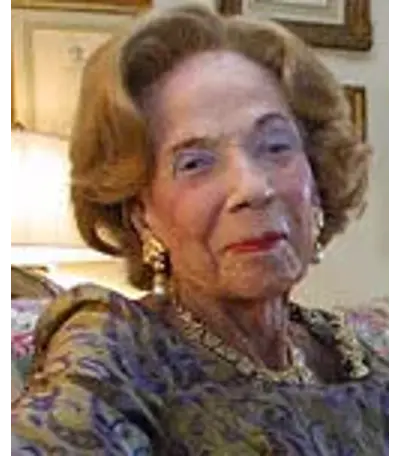
Roberta Brooke Astor was an American philanthropist, socialite, and writer who was the chairwoman of the Vincent Astor Foundation, which had been established by her third husband, Vincent Astor, son of John Jacob Astor IV and great-great grandson of America's first multi-millionaire, John Jacob Astor. Brooke Astor was the author of two novels and two volumes of personal memoirs.
