Tariq Ramadan Quotes
I focus on Islamic applied ethics in many fields, and here I am saying that coming back to the Qu'ran and the sunnah as our reference point does not mean that we depend for our ethics on 'Islam as opposed to the others'.
Ramadan, Tariq. Radical Reform: Islamic Ethics and Liberation. Oxford UP, 2009.

Theological & Legal Expert. The Sunnah, like the Koran, has statements of the Prophet, Mohammad. A fatwa is a religious legal ruling. This particular Fatwa shows the great difference between the Islamic State and a Republic or Democracy. In the latter forms, any religious practices must be consistent with the Constitution. Even though blasphemy might be prohibited by a religion, the United States Constitution for example protects anyone’s right to be blasphemous. In the Islamic system any constitution or law is subservient to and must be consistent with, the sayings of the Prophet Muhammad. In that sense, unless the Muslim populated nation is secular like Turkey, then the governments are partial or total theocracies.

The Governor had introduced Sharia, Islamic Law, into his state. When a woman was sentenced to death by stoning, the Federal Government nullified the sentence on the ground that stoning was not morally right nor was a death penalty for her actions. The woman was not executed

This stricture would seem to prohibit the suicide bomber and other terrorists who kill civilians. However, the terrorists and those who support them observe that this quotation is not from the Koran and other passages of the Koran override this instruction in many contexts. Most American Muslims hold with this view of the Prophet’s and morally oppose indiscriminate terrorism in all cases. This volume roughly is to Islam what the Gospels are to Christianity. To most Muslims The Sunnah is a collection of holy material on the life of Mohammed. It is not of the force or importance as the Koran, but it is revered.

This is a very important point as most Muslims believe that the actual wording of the Sharia—Islamic Law—comes from the Prophet directly and are not the words of various legal scholars which is just what they are. Needless to say, there are many differences and even contradictions depending on time and the particular scholar. Islam however has no authority that religiously is higher than any other. In that respect, it is like Judaism. There is not a recognized religious hierarchy as there is in Christian churches.

Nasr Hamid Abu Zayd, 1943-2010, was an modernistic Egyptian Islamic Scholar and a Professor at the University of Cairo. One of his writings argued that the discriminatory tax that the Koran specified for Christians and Jews in an Islamic nation was not fair or consonant with modern thought regarding freedom of religion and the rights of minorities. Some fundamentalist were outraged and charged him with Apostacy for criticizing a Koranic prescription. He was convicted and lost his professorship. That was the least of his problems. Since he was an apostate, he was not a Muslim the Egyptian Courts ruled, and therefore his wife, a Muslim, could not legally remain married to her. His marriage was legally dissolved and he was threatened with death by fundamentalists forcing him and his wife to go into exile in Holland where he taught at the Utrecht University. He never returned.

This view is typical of most religiously educated Muslims and accounts in large part for the fact that the Islamic world is so scientifically backward—especially in the context of the great Islamic scientific development around 1000 AD. Religiously Islam closed and so did the entire outlook of the people, and the existing religious norm accounts for most of the backwardness of Islamic lands.


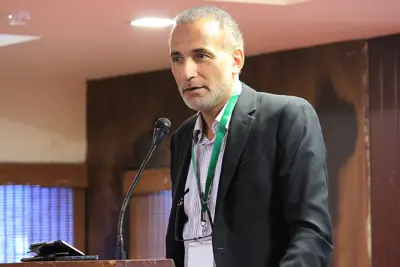
Tariq Ramadan is a Swiss Muslim academic, philosopher, and writer. He was a professor of contemporary Islamic studies at St Antony's College, Oxford and the Faculty of Theology and Religion, University of Oxford, but as of 2018 is taking an agreed leave of absence. He is a visiting professor at the Faculty of Islamic Studies at Hamad Bin Khalifa University in Qatar, and the Université Mundiapolis in Morocco. He is also a senior research fellow at Doshisha University in Japan. He is the director of the Research Centre of Islamic Legislation and Ethics (CILE), based in Doha. He is a member of the UK Foreign Office Advisory Group on Freedom of Religion or Belief. He was elected by Time magazine in 2000 as one of the seven religious innovators of the 21st century and in 2004 as one of the 100 most influential people in the world and by Foreign Policy readers (2005, 2006, 2008–2010, 2012–2015) as one of the top 100 most influential thinkers in the world and Global Thinkers. Ramadan describes himself as a "Salafi reformist".
