Nelson Mandela Quotes
I came across few whites as a boy at Qunu. The local magistrate, of course, was white, as was the nearest shopkeeper. Occasionally, white travelers or policemen passed through our area. These whites appeared as grand as gods to me, and I was aware that they were to be treated with a mixture of fear and respect.
Mandela, Nelson. Long Walk to Freedom: The Autobiography of Nelson Mandela. Little, Brown and Company, 1994.


This concept was one of the main selling points that the Southern leadership used to invest poor whites in the Confederate cause. The poor white, no matter how bad off he’s was, cold always see himself above the Negroes who were fit for being a servant while he was above that. See Jefferson Davis Quotation

Many Irish use the term “race” in a cultural sense. To them, the Irish are a different race from the English or the Italians.

The highway was planned to go through a poor neighborhood which had a high percentage of Black residents—all of whom would have to find other housing and move to make room for the highway. If the government plans a highway through a wealthy area, the cost to condemn and pay for the land will be much greater than if a poor neighborhood is acquired. For urban highways, the poor almost always bear a disproportionate share of the inconvenience while the major benefit inures to the wealthy and middle class. Abbot had been a labor organizer and a professional artist before he entered politics. The graphic is of his famous poster which by itself stopped the plans to build the highway very quickly.


In the Nez Perce and most other Native American societies, there were Chiefs and occasionally, for special circumstances, War Chiefs, but few if any other officials, thus producing a very flat, egalitarian society. But the whites had many layers of bureaucrats and petty officials. Governors, The President, Members of Congress, State Legislators, Generals, Sheriffs, Indian Agents, tax collectors, and the like. On the Papago Indian reservation, there was great difficulty on a construction project as even the concept of a work foreman was an uncomfortable notion. No Papago wanted to be directed or ordered about by anyone else even on a work gang. And do no one wanted to assume a position of authority or be responsive to a fellow other than the Chief and the tribal elders.

Criticizing the Southern FBI agents for not enforcing Civil Rights Laws and protecting Blacks:


The Boers were lower class, uneducated, farmers from Holland who came to South Africa before the English did. They were at the bottom of the Dutch socioeconomic ladder. Unlike the English who were interest in establishing a trading colony, the Boers just wanted to own and farm the land and use blacks as slave or cheap labor. The Dutch Government and Trading companies lost interest in South Africa as there were much more profitable parts of the world, and they felt no obligation to the Boers whom they were glad to be rid of. So the Boers found themselves having to follow the British laws and rules of the British Colonial Office. Slavery was outlawed, and Blacks could be educated and become citizens under British law. They could own land, and contest the right of the Boers who had settled in some uninhabited land and some that was owned by Black tribes. The Blacks outnumbered the whites in general and the Boers, and there were educated Blacks who “outclassed” the still relatively uneducated Boers. So the Boers, fighting for their “way of life” set up their own area in Southern Africa and claimed independence. But Blacks claimed that it was their land and looked to the British to exercise English law. The Boer war ensued. Although the Boers lost the war, the bred at a much faster rate than the English, many of whom did not even have their families in South Africa. By the end of WWII, the Boer white majority controlled the government and kept the majority Blacks from voting and having full citizenship rights. They dominated Apartheid South Africa until the Black Revolutionists obtained control and although Black and white relations are better in South Africa than most countries, the extemeist Boers and most militant Blacks are in political, but not violent, conflict. Churchill and the British have always perceived themselves as being caught in the middle between the Boers and the Blacks.


This is an important quotation because Buckley was the leading intellectual conservative of his day. And he held these racist views more than a decade after the Civil Rights Act and Voting Rights Act were passed. Buckley was an elitist with an Ivy League education, and he did believe that there was nothing inherent or permanent in the Southern Black inferiority, but there were few people of his educational level who had these racist beliefs. Not all conservatives of the time were as racist as Buckley. Even into the 21st century Conservative groups like the Tea Party had a strong but minority vestige of racism.


The “We” to which he was referring were the British officials and civil servants who governed all of India as a colony of the British Empire.
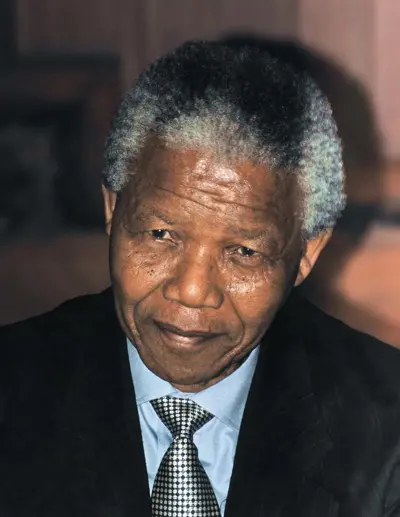
Nelson Rolihlahla Mandela was a South African anti-apartheid revolutionary, political leader and philanthropist who served as President of South Africa from 1994 to 1999. He was the country's first black head of state and the first elected in a fully representative democratic election. His government focused on dismantling the legacy of apartheid by tackling institutionalised racism and fostering racial reconciliation. Ideologically an African nationalist and socialist, he served as the president of the African National Congress (ANC) party from 1991 to 1997.
