Sam Houston Quotes
I am aware that in presenting myself as an advocate for the Indians and their rights, I shall claim but little sympathy from the community at large, and that I shall stand very much alone....I feel it is my imperative to adhere to ... a principle enduring as life itself. That principle is to protect the Indian against wrong and oppression, and to vindicate him in the enjoyment of rights which have been solemnly guaranteed to him by this Government.
Sam Houston, 1793-1863, Governor of Tennessee, First President of the Republic of Texas, U.S. Congressman (Democrat, TN) & U.S. Senator (Democrat, TX), Senate Debate, February 14, 1854
Sourced by: Eigen's Political and Historical Quotations


The intentions of the Founding Fathers towards the Indians was decent, respectful, and well intentioned. However, there was not enough of a system of enforcement or the will to enforce when the greed of the average whites grew too great. Many settlers saw these vast lands and could not see any harm in using a few acres for their farm. And if there had been only a few, there would have been little trouble. However, the settlers kept coming and coming and soon the Indians began to push back. In a sense, it was a class problem. The members of the Continental Congress who wrote the Northwest Ordinance were educated, affluent men who had plenty of land. Most of the men who contested for the Indian lands had little land or were newly affluent and saw few limits to America.


Doty acquitted Chief Oshkosh who had murdered another Indian in retaliation of the murder of one of his tribe. Under the Indian customs of the time, revenge killings were normal and expected. The white citizens were outraged and voted Wisconsin’s first judge out of office. He later became Governor of the territory and when Wisconsin became a state, Doty became its Congressman.


Cass was negotiating with the Shawnees and Cherokees to persuade them to move to land west of the Mississippi. See John Henry Eaton for similar unkept promises.


In the only presidential Special Message to Congress on the subject of Indians in American history:

The issue of slavery which had been suppressed in Congress for the first decades of the nation broke out when Missouri statehood was considered. By previous agreement, slavery was not even discussed in Congress but the time period elapsed. Tallmadge not only proposed that no more slaves could come into Missouri {613176} but most shocking to the Southerners was that every person born in the new state would be free at the age of 25. In a generation, there would be no more slavery in Missouri and there would be no economic compensation for slave owners at all. The House of Representatives accepted the amendment, but it failed in the Senate. At that time, Senators were not elected by voters but were appointed by the state legislators and the Southern slave states had a disproportionate share of the senate from a population point of view. But what this quotation shows clearly that a majority of the country in 1819 were opposed to slavery and were willing to end it without compensation.

She was brutally murdered, many say executed.


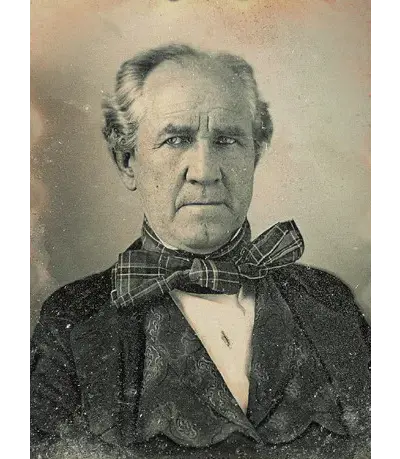
Samuel Houston was an American general. He was an important leader of the Texas Revolution, Houston served as the first and third president of the Republic of Texas, and was one of the first two individuals to represent Texas in the United States Senate. He also served as the sixth governor of Tennessee and the seventh governor of Texas, the only American to be elected governor of two different states in the United States.
