Walter Kohn Quotes
However, while the Nazi barbarians and their collaborators threatened the entire world, I could not accept his philosophy and, after several earlier attempts, was finally accepted into the Canadian Infantry Corps during the last year of World War II.
Kohn, Walter. "Walter Kohn - Biographical." Les Prix Nobel. The Nobel Prizes 1998, edited by Tore Frängsmyr, Nobel Foundation, 1999.


The military security people were so used to ferreting out communists in the 1930s that they had a hard time adjusting to the fact that the security risks or people who might have German connections or backgrounds. Many immigrant scientists were recruited for work on the Manhattan project to build the atomic bomb and they only did security clearances. The military security people kept checking on any communist background they might have had as opposed to possible connections with fascist organizations. By the end of the war they had adjusted but then had to go back to looking for communists as the Cold War evolved.


This was the first day of WWII and Hitler’s armies seemed invincible. Kaplan was one of the few who at that time predicted allied victory. He was not even wrong about his own fate. He and the vast majority of the Jews in the Warsaw ghetto never survived.


Leval was an appeaser and a collaborator with the Nazi’s. He led the government in name but the Germans really controlled the country. His actions killed tens of thousands of French men and women by turning them over to the Germans. After the Germans were defeated in WWII, Leval was shot as a traitor by the Free French forces. See {587231}, {587228} and {587230}.

The general was replacing George S. Patton as commander of the Third Army. Patton had opposed the deNazification policy of the allies and caused a great deal of public relations difficulty for the army command and the administration, as reporters would frequently print his views. Truscott was one of Patton’s loyal assistants. The minute he took over, the press wanted to find out if his views were the same as his former boss regarding the Nazis. They were quite different. Reporters had no story.


FDR was right about Russia being a major factor in stopping Hitler, but partially wrong about the danger of Russia. The Soviets never did dominate Europe although the tried, but they did dominate Eastern Europe.


In 1938 Germany had rearmed and resumed its aggressive designs of expansion. Hitler wanted the Sudetenland part of Czechoslovakia and threatened an invasion of that country. England had France had a treaty obligation to militarily support Czechoslovakia if it were attacked. British Prime minister Neville Chamberlain and the French were desperately trying to avoid war, not realizing that with Hitler, that position was the very thing that would bring on war. So they agreed to Hitler’s demand and allowed Czechoslovakia to be partitioned and the Sudetenland was annexed to Germany. This craven appeasement emboldened Hitler who then decided to conquer all of Europe as he had no serious opposition from France and England—the two powers that might have stopped him. (At the time, the French had a larger army than the Germans.)

He was a viscious anti-Semite who attracted to his party extreme right wingers, Nazi Sympathers and apologists for the Vichey Franch government. The party was rejected by the majority of French voters, but when his daughter took over the party, she was not an anti Semite but foudn it hard to shake the party's image which was alaysa associated with her name even when she actually kicked her father out of the party.


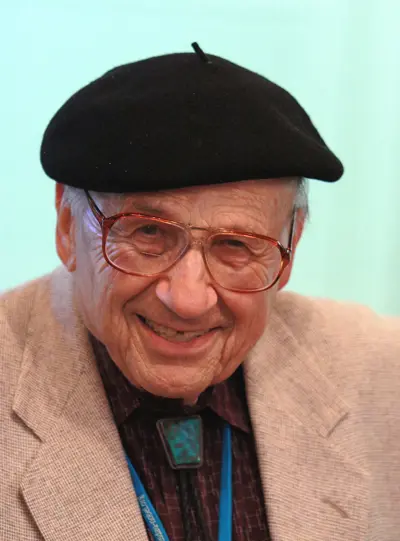
Walter Kohn was an Austrian-American theoretical physicist and theoretical chemist. He was awarded, with John Pople, the Nobel Prize in Chemistry in 1998. The award recognized their contributions to the understandings of the electronic properties of materials. In particular, Kohn played the leading role in the development of density functional theory, which made it possible to calculate quantum mechanical electronic structure by equations involving the electronic density (rather than the many-body wavefunction). This computational simplification led to more accurate calculations on complex systems as well as many new insights, and it has become an essential tool for materials science, condensed-phase physics, and the chemical physics of atoms and molecules.
