George III Quotes
His Britannic Majesty acknowledges the said United States … to be fee, sovereign, and independent states.
The document was signed in his name by his ministers.
George III, 1738-1820, King of England & Ireland, King of Hanover, Treaty of Ghent, September 3, 1783
Sourced by: Eigen's Political and Historical Quotations


The professor was lecturing to British university students about 75 years after the American Revolution. The “American War” is the term the British use for the American Revolution.


This was written more than a year before the “blows” began. It took time to ship the men and supplies to America and the British did not handle that task with much efficiency.


In most revolutionary settings leaders have to persuade people who have voted with no success to turn to the rifle. In Ireland at this point, almost all the nationalsits knew that the rifle would help them but they were not sure that a vote would have the effect of a bullet.


The Texans wanted independence from Mexico and this quotation illustrates their three possible alternatives. Most Texans wanted to join the United State, but the United States was not very enthusiastic about having Texas. In a sense, Texas was made up of the malcontents, failures and riffraff from the United States. Many felt the nation was good to be rid of them. So initially, Texas was an independent republic. However, public and elite opinion began to change, and finally Texas was admitted.

Because the early nation's government was still in a state of becoming, foreign powers were hesitant to do business and conclude treaties with the newly-formed United States of America:

Majority public opinion does not always prevail in a modern democracy as there are Constitutional limits on the prerogatives of the majority. Also leadership has played a strong role in America’s development where strong leaders have been able to do the right thing despite contrary public opinion.
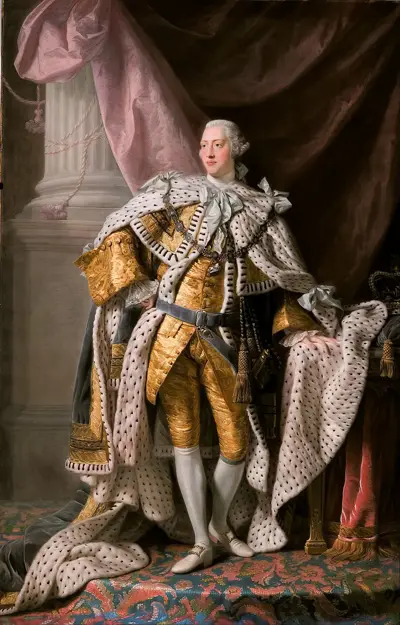
George III was King of Great Britain and Ireland from 25 October 1760 until the union of the two kingdoms on 1 January 1801, after which he was King of the United Kingdom of Great Britain and Ireland until his death in 1820. He was concurrently Duke and Prince-elector of Brunswick-Lüneburg ("Hanover") in the Holy Roman Empire before becoming King of Hanover on 12 October 1814. He was a monarch of the House of Hanover, but unlike his two predecessors, he was born in Great Britain, spoke English as his first language, and never visited Hanover.
