Walt Whitman Quotes
He got badly hit in his leg and side at Fredericksburg that eventful Saturday, 13th of December. He lay the succeeding two days and nights helpless on the field, between the city and those grim terraces of batteries. His company and regiment had been compelled to leave him to his fate. To make matters worse, it happened he lay with his head slightly down hill, and could not help himself. At the end of some fifty hours he was brought off the field, with other wounded, under a flag of truce. I ask him how the rebels treated him as he lay during those two days and nights within reach of them -- whether they came to him -- whether they abused him? He answered that several of the rebels, soldiers and others, came to him at one time and another. A couple of them, who were together, spoke roughly and sarcastically, but nothing worse. One middle-aged man, however, who seemed to be moving around the field, among the dead and wounded, for benevolent purposes, came to him in a way he will never forget; he treated our soldier kindly, bound up his wounds, cheered him, gave him a couple of biscuits and a drink of whiskey and water, and asked him if he could eat some beef.
Despite the horrors and war crimes of Andersonville Prison, there were many instances of both sides of the Civil War assisting the enemy when wounded. Also, the primitive facilities for caring for the wounded, who would sometimes lay on a battlefield for 2-5 days before anyone got around to assisting them if they were still alive. Walt Whitman, in addition to being a great poet, was a nurse.
Walt Whitman, 1819-1902, Poet & Journalist, Description of the Treatment of a Wounded Union Soldier by Confederate Soldiers, 1863
Sourced by: Eigen's Political and Historical Quotations

The Patent Office was one of the most imposing buildings in Civil War Washington. There was truly a society at war where every resource was put to us for the war effort. Walt Whitman, in addition to being a great poet, was a nurse.


Sherman had friends in the South and he saw rebellion and war coming. Most Southerners had a romanticized view of war and were so wrapped up in trying to preserve their economic and cultural way of life that they did not think through the implications of such a war. After and during the war, he was particularly angry with the Southerners who had brought such terrible casualties and destruction upon the land and its people.


Committee of the Congress. This was the prevailing Congressional and public view except for the South which had coalesced around an intellectual rationalization. See {618013}.

That is the way he was killed. The phrase, “We are bound to believe that, anyhow” indicates that Stuart really realized how futile the Southern war effort would be but loyalty and patriotism required him to suspend his rational belief structure.

The Civil War produced more deaths than all other American wars put together. Lee’s skill and gentlemanly demeanor subdue the fact that his treasonous efforts caused more American soldiers to die than the entire Second World War—and yet some Americans regard him as a hero while others see him as a traitor.

The convoy was heading for the city of Alleppo that had been under siege by the government for weeks. 22 UN Aid Workers were killed and half the cargo was destroyed. Syria had been in a Civil War for a number of years, and the Government of Bashar al-Assad had committed one atrocity after another. A cease fire had been agreed to and the UN notified all parties to the war about the humanitarian convoy’s schedule and route. It was not known whether the government had decided to attack the convoy to put more pressure on the people in Aleppo to end their rebellion or the attack was made by local commanders of government troops who did not want to see the pressure on Aleppo lifted.


This was the exact political logical scenario that German socialist Bebel had predicted a few years earlier--{642075}. “Hectacomb” was an ancient Greek term referring to the public sacrifice of the blood of 100 oxen. It developed a more generalized meaning referring to making a very large human sacrifice of life for a national purpose.

He stated that he had a vision and made these two prophesies that indeed came true. The first was the South Carolina secession starting the Civil War. The second, when the North used former slaves as soldiers who fought their old masters.

President Lincoln and Several of the Commanding Union Generals had declared that black slaves were free during the midst of the Civil War under the legal theory that if the slaves were property of the rebels, then they cold be seized as “contraband” and removed from the control of those who had committed treason. The question was, what would happen to those now free Negroes after the war? Many Negro leaders were anxious that if there were surrender, then the status quo ante might prevail and the Negroes—many have who had fought for the Union might be returned to slavery. This speech by the Secretary of State alarmed them further. This is why the Emancipation Proclamation was so important and even that might have been overturned by a subsequent President. This is why Lincoln, the white radical Republicans and the Black leadership placed so much emphasis on passing the 13th Amendment.
His perception that the loss of the war for the South was God’s retribution for Southern Slavery and treason was very common in the North. The young man was shocked at the difference between the educational levels of he and his Michigan comrades vis a vis their Southern counterparts. The Southern slave-centered economy didn’t provide a very good education, even for its own white citizens. 150 years after the Civil War, the South was generally behind the rest of the country in average educational.achievement.


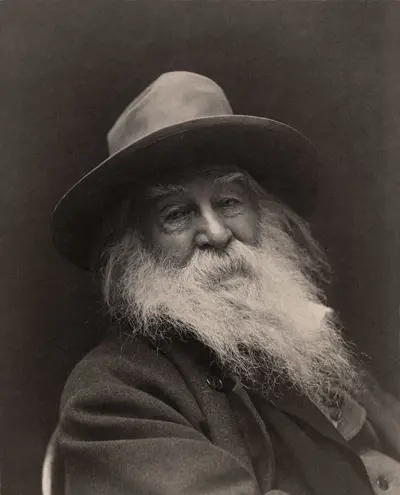
Walter Whitman was an American poet, essayist, and journalist. A humanist, he was a part of the transition between transcendentalism and realism, incorporating both views in his works. Whitman is among the most influential poets in the American canon, often called the father of free verse. His work was controversial in its time, particularly his poetry collection Leaves of Grass, which was described as obscene for its overt sensuality. Whitman's own life came under scrutiny for his presumed homosexuality.
