James Connolly Quotes
For generations the shamrock was banned as a national emblem of Ireland, but in her extremity England uses the shamrock as a means for exciting in foolish Irishmen loyalty to England. For centuries the green flag of Ireland was a thing accurst and hated by the English garrison in Ireland, as it is still in their inmost hearts. But in India, in Egypt, in Flanders, in Gallipoli, the green flag is used by our rulers to encourage Irish soldiers of England to give up their lives for the power that denies their country the right of nationhood.
Executed by the English for his part in the Easter Uprising.
James Connolly, 1868-1916, Founder, Irish Socialist Republican Party, Military Commander of Republican Forces in Dublin, Irish Founder of the Irish Socialist Republican Party, Co-Founder Industrial Workers of the World (IWW), The Irish Flag, 1916
Sourced by: Eigen's Political and Historical Quotations


Executed by the English for his part in the Easter Uprising.


He had been exiled to the United States.

The 69th Regiment, the first and original division of the Irish Brigade, has been one of the most decorated and successful American battle units since the Civil War. It was originally formed with Irish Immigrant Volunteers by the authority of the Secretary of War. The Irishmen designed their own regimental battle flag which not only was composed of Irish motifs such as the Harp of Erin, but this was the only text in the red banner but it was in Gaelic. The battle flag could be an Irish Army regimental flag as there is nothing on the flag to identify it with America. Although the flag did not, the brigade did with their blood left on the battlefield of every American war up to today. Ironically, this may be the only national military unit in history who operated with a slogan extolling another country.


The Irish Earls of Ulster, after a failed rebellion against English rule, fled to the European continent. As Chichester realized, this created an opportunity for the King to name new Earls and grant them the lands and possessions of the Earls who had fled. And since the Irish people were loyal to their traditional Earls. He suggested that English and Scots colonists be recruited to settle the lands. The King agreed and referred to the project as the “Ulster Plantation”. This was the reason that Northern Ireland had a much larger Protestant population percentage than the rest of Ireland and wanted to remain part of England when Ireland obtained its independence.
He was a Protestant liberal and opposed to the English rule of Ireland and the discrimination against the Catholics. To make an example to inhibit Irish protestants from joining the Society of United Irishmen, he was accused of giving an oath to a British Soldier that he would support Irish independence. This had been made a capital crime shortly before. Actually, it was another member of the Society who administered the oath, but the prosecutor arranged for perjured testimony to convict the more prominent Orr. His execution was remembered by liberal Catholics and Protestants alike and in the rebellion the following year the rebel battle cry was “Remember Orr”.


The “Defenders” were the Catholic terrorists who along with their Protestant Orange Order counterpart were in sporadic acts of violence and terrorism with no military objective. The French Army was not to sail for Ireland where they would link up with The Defenders and take Ireland from the English. The invasion failed when terrible weather forced the French troop ships carrying more than 45,000 invading soldiers to cut their anchor cables and return to France.


The Chief Secretary, Lord Castleregh, had put forward a resolution to bring about the unification of Great Britain and Ireland under the single British Parliament at Westminster. He and his allies had bribed a number of the Irish MPs to support the union. With Union some Irish MPs would then be able to win seats representing Ireland in the British Parliament. Although Grattan and most of the Orangemen opposed the Union, 4 months later, the bill passed comfortably. Ironically, Grattan was one of the Irish MPs whose popularity won a seat in the unified British Parliament.

At that time, Russia and Germany were autocracy, and the ruler could simply take the English money and force the soldiers to fight in a war they had not stake in nor understood.
He had been exiled to the United States.
Executed by the English for his part in the Easter Uprising. Most revolutionaries seeking independence become so focused on their revolution that they begin to believe that independence will solve all problems. Connelly was one of the more sophisticated ones who realized that many of the economic problems of Ireland had nothing to do with independence or the lack thereof.


Shortly after the failed uprising the Mufti went to Berlin where he was made a Nazi SS Major General and set up Arab SS Units to exterminate the Jews in the Middle East. See {586894}.

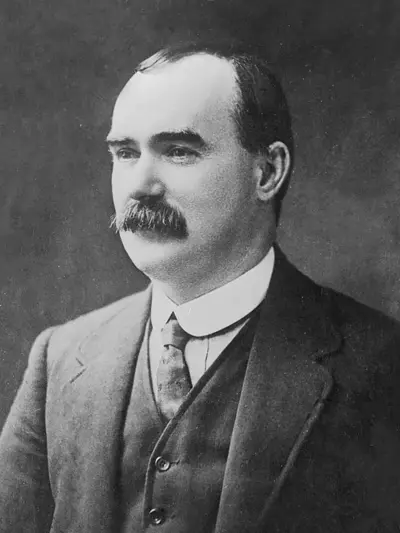
James Connolly was an Irish republican, socialist and trade union leader. Born in the Cowgate area of Edinburgh, Scotland, to Irish parents Connolly left school for working life at the age of 11, and became involved in socialist politics in the 1880s.
