Isaac Newton Quotes
Fidelity and allegiance sworn to the King is only such a fidelity and obedience as is due to him by the law of the land; for were that faith and allegiance more than what the law requires, we would swear ourselves slaves and the King absolute; whereas, by the law, we are free men, notwithstanding those oaths.
Newton, Isaac. "An Argument on the Oaths of Allegiance and Supremacy" (1689). The Correspondence of Isaac Newton, edited by H.W. Turnbull, vol. 3, Cambridge UP, 1961, p. 12.


Typical of the times, the king was accountable to no one for anything. 200 years later, most of the world have accepted the principle that no one is above the law and that every leader is accountable to the people.


Drake named the land Nova Albion.


The Emperor had made his brother King of Holland, thinking of it as an unimportant backwater of the French Empire. But Louis took his oath and job very seriously, and although he did not have the great talent of his brother, he made a serious effort to be a good king.


England had, under Henry VIII, left the Roman Catholic Church where the King replaced the Pope as head of the English Church. Henry’s successors then had to organize and manage the national Christian church. James was discussing the hierarchy of the Church of England and there was a suggestion that Bishops be eliminated and have every priest directly responsible to the crown. Bishops would be powerful figures who might form a power center. (They did later). However, King James I observed that the King is God’s choice and rules by divine right. So there had to be bishops to crown kings. The bishoprics were retained.

Some of the Patriots of Early America realized that the oppressions of British rule were coming from Parliament and initially took the position that only the King could make laws for the colonies and not Parliament. Therefore, they were as Englishmen challenging illegal English laws. Most American hostility was directed at Parliament and not the King. However, once there was any physical resistance, King George came down with such a heavy hand that American hatred transferred to him. For related quotes on the King/Parliament issue, see {639145}, {639143}, {639142}, {639141}, {639140}, & {639137}
While he thought a people had a right to have a king, he also made radical statements regarding the British and their monarchy. See {633999}. The right of a people to have a king was also stated by the President of Harvard in that period— {633996}.

Note that in addition to getting rid of the authority of the King, New York—over a decade before the Bill of Rights and the First Amendment, provided for a ban on an established church or favoring one Christian sect over another. Even then New York was a multi religious and multi ethnic society with its strong Dutch tradition along with the English tradition. New York did not go as far as the First Amendment would do later in terms of freedom of religion. NY only mentioned Christian sects. However they did implement separation of church and state and an establishment clause. See {621429} for another clause that ensures separation of church and state.

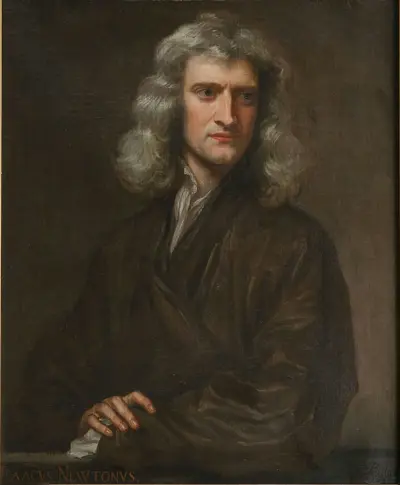
Sir Isaac Newton PRS was an English mathematician, physicist, astronomer, theologian, and author (described in his time as a "natural philosopher") who is widely recognised as one of the greatest mathematicians and most influential scientists of all time and as a key figure in the scientific revolution. His book Philosophiæ Naturalis Principia Mathematica (Mathematical Principles of Natural Philosophy), first published in 1687, established classical mechanics. Newton also made seminal contributions to optics, and shares credit with Gottfried Wilhelm Leibniz for developing the infinitesimal calculus.
