Elmer S. Dundy Quotes
During the fifteen years in which I have been engaged in administering the laws of my country, I have never been called upon to hear or decide a case that appealed so strongly to my sympathy as the one now under consideration On the one side, we have a few of the remnants of a once numerous and powerful, but now weak, insignificant, unlettered and generally despised race; on the other, we have the representative of one of the most powerful, most enlightened, and most Christianized nations of modern times. On the one side, we have the representatives of this wasted race coming into this national tribunal of ours, asking for justice and liberty to enable them to adopt our boasted civilization, and to pursue the arts of peace, which have made us great and happy as a nation; on the other side, we have this magnificent, if not magnanimous, government, resisting this application with the determination, of sending these people back to the country which is to then less desirable than perpetual imprisonment in their own native land.
Standing Bear and some other Indians left the Indian territory where the government had assigned their tribe and with an invitation went to live on another Indian reservation designated for another tribe. The Government sent the military police to take the Indians back to the Indian Territory. The Indians claimed that they had the right to live wherever they wanted and did not have to live in the place the government had assigned them. The Indians won and since then, Indians like all other Americans were free to go wherever in the country that they wanted so long as they were not trespassing or violating other laws.
Elmer S. Dundy, 1830-1896, Federal Judge, United States, ex rel. Standing Bear, v. George Crook, a Brigadier-General of the Army of the United States
Sourced by: Eigen's Political and Historical Quotations


Moss and two other blacks had had the temerity to open a grocery store. White competitors attempted to have the city authorities close the store. When that failed, a mob took the three Black owners to the city limits and shot them all to death. Moss was a close friend of Ida B. Wells, and his lynching started her on her no famous anti-lynching expose and campaign. See {44393} for her initial response.

Samuel Langhorne Clemens, 1835-1910. He was describing the generation of Chinese immigrants to the West Coast who were discriminated against and treated badly by the established population.

The Boers were lower class, uneducated, farmers from Holland who came to South Africa before the English did. They were at the bottom of the Dutch socioeconomic ladder. Unlike the English who were interest in establishing a trading colony, the Boers just wanted to own and farm the land and use blacks as slave or cheap labor. The Dutch Government and Trading companies lost interest in South Africa as there were much more profitable parts of the world, and they felt no obligation to the Boers whom they were glad to be rid of. So the Boers found themselves having to follow the British laws and rules of the British Colonial Office. Slavery was outlawed, and Blacks could be educated and become citizens under British law. They could own land, and contest the right of the Boers who had settled in some uninhabited land and some that was owned by Black tribes. The Blacks outnumbered the whites in general and the Boers, and there were educated Blacks who “outclassed” the still relatively uneducated Boers. So the Boers, fighting for their “way of life” set up their own area in Southern Africa and claimed independence. But Blacks claimed that it was their land and looked to the British to exercise English law. The Boer war ensued. Although the Boers lost the war, the bred at a much faster rate than the English, many of whom did not even have their families in South Africa. By the end of WWII, the Boer white majority controlled the government and kept the majority Blacks from voting and having full citizenship rights. They dominated Apartheid South Africa until the Black Revolutionists obtained control and although Black and white relations are better in South Africa than most countries, the extemeist Boers and most militant Blacks are in political, but not violent, conflict. Churchill and the British have always perceived themselves as being caught in the middle between the Boers and the Blacks.

Many Irish use the term “race” in a cultural sense. To them, the Irish are a different race from the English or the Italians.

President Jackson was the most extreme President in terms of abuse of Native American Rights. His racist views and policies were a large reason for the continuing problems that Indians have had gaining fair treatment and equality. Jackson was the only American President who ever refused to obey a Supreme Court decision when he removed the Cherokee Indians from their lands, despite the fact that the Supreme Court had ruled that such a removal was illegal. See {623405} for other Jackson views on Indian policy.
At the time, some Palestinian Arabs claimed exclusive rights to the territory on the grounds that Arabs had dominated the area for the longest period of time. They gave no credence to the fact that the Jews had dominated the area and it was the center of their kingdom for many years before—that Jews had constantly lived in the area of longer than the Arabs, nor did they give any credence to the fact that the Christians had conquered the area from the Muslims during the Crusades.
He was writing about the natives of what is today Indonesia. At the time Indonesia was controlled by the Dutch. Heurmius was writing about the difficulty in converting Indonesians to Christianity.


The Iroquois were among the most sophisticated of the North American Indian Tribes. They also were highly assimilated into the American society. In the next decades, they would switch their political position when New York State provided better legal guarantees for Iroquois land than the Federal Government. By the end of the 20th Century, led by the Iroquois, the Indian residents of New York State had the same level of earnings as the white man—and that was with NO INDIAN GAMING.


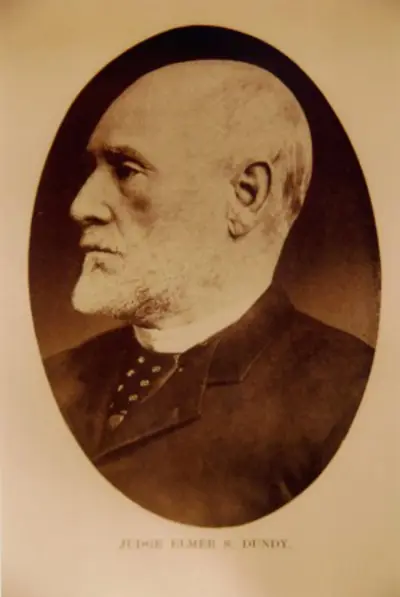
Elmer Scipio Dundy was a United States District Judge of the United States District Court for the District of Nebraska. He was the namesake of Dundy County, Nebraska.
