Marquis de Lafayette Quotes
Defender of the liberty that I idolize, myself more free than anyone, in coming as a friend to offer my services to this intriguing republic, I bring to it only my frankness and my good will; no ambition, no self-interest; in working for my glory, I work for their happiness.
Lafayette, Marie Joseph Paul Yves Roch Gilbert Du Motier. Memoirs, Correspondence and Manuscripts of General Lafayette. Vol. 1, Saunders and Otley, 1837, p. 11.


Beaumarchais had provided the Americans with credit in the amount of ½ million French Livres. However, Beaumarchais served the French King Louis XVI as a spy and advisor on foreign affairs. The money had been secretly provided by the French government to help the American cause while still being able to officially deny to England that they were in any way involved in the rebellion. The American agent, Silas Dean, who arranged for the loan saw through the ruse. See {624186} and {624184}.


In 1932 FDR was elected president by a desperate nation in the midst of the great depression. A month before the presidential inauguration an assassin attempted to murder the President-elect, but instead fatally shot the Mayor of Chicago who was talking with Roosevelt:


The motto was worn on their uniforms which unlike the blue of the rest of the American army was white as can be seen in the famous paining by muralist David R. Wagner. Rhode Island offered freedom to all slaves who would enlist. It not only included Negroes but Indian slaves as well. See {613949} and {614120} for details. The motto itself is interesting in that there was little concept of a country then as most Americans identified themselves as Virginians, New Yorkers or Rhode Islanders. There was no Constitution—only a confederation of States. But the former slaves joining the regiment had never voluntarily associated themselves with Rhode Island, and the first free decision they made was to join the regiment and have a new country.


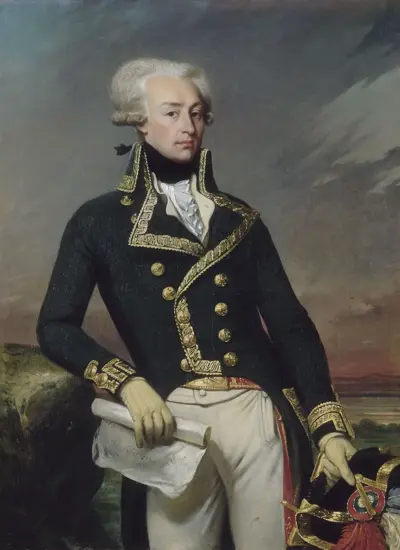
Marie-Joseph Paul Yves Roch Gilbert du Motier, Marquis de La Fayette, known in the United States as Lafayette (/ˌlɑːfiːˈɛt, ˌlæf-/, French: [lafajɛt]), was a French aristocrat and military officer who fought in the American Revolutionary War, commanding American troops in several battles, including the siege of Yorktown. After returning to France, he was a key figure in the French Revolution of 1789 and the July Revolution of 1830. He has been considered a national hero in both countries.
