Albert Bushnell Hart Quotes
Besides paid white laborers, there was everywhere a class of white servants bound without wages for a term of years, and a more miserable class of Negro slaves.
Hart, Albert Bushnell. Formation of the Union, 1750-1829. Longmans, Green, and Co., 1892, p. 18.


depending on the term of the sentence Many criminals in England were sentenced to indentured servitude in America for a number of years depending on the crime.

Nott, a Southerner who owned slaves, was not only an apologist for slavery as this quotation illustrates, but also wrote on his theories of race. Nott was one of the writers about race that Darwin singled out as being completely wrong in 1871: The Descent of Man.


John Sutter was an immigrant to California from Switzerland where he became a Mexican citizen. Slavery was outlawed in Mexico and its territories, yet Sutter and others maintained Indians as slaves. The Roman Catholic Missions of California also kept Indian slaves. This quotation is historically important because many people never realized that slavery was prevalent in California.

The perception of the necessity of slavery was evident very early in the South.
Most of us think the California was not a slave state, but in the early 1850s the California law (such as it was) allowed a slave owner to “sojourn” in California with his property that could include slaves. A number of Southern save owners took slaves to the California gold fields to do mining. There was a great deal of resentment on the part of the other miners and the free labor of the territory. In 1855, slavery in California was abolished.

Many historians of higher education to not agree with Wilder’s overall generality. However, it was certainly the case that slavery was a major factor in generating the funds for some early universities in the North, but others were “hotbeds” of abolition from their very inception.


This concept was one of the main selling points that the Southern leadership used to invest poor whites in the Confederate cause. The poor white, no matter how bad off he’s was, cold always see himself above the Negroes who were fit for being a servant while he was above that. See Jefferson Davis Quotation


Generally, Jefferson was not in favor of whipping slaves, but this quotation shows that he essentially accepted the basic principles of Southern Slavery—including the one that says if the person does not want to work for you, you may whip, beat, or torture him or her to produce “reasonable work.” This acceptance of slavery and profiting from it, is the terrible blot on the record of the man who otherwise was among the few greatest of Americans.


This is one of the major reasons that Slavery was so hard to end in the South. At the time, the dollar value of the Southern slaves was greater than the value of all the land, factories, inventory, and capital equipment of the South. Slaves were not only capital, they were the largest component of Southern capital and Southern wealth. There were numerous ideas of paying slave owners for the freedom of their slaves, and if this was done, it would have been far less expensive in money alone than the Civil War cost. However, the Southern leadership, like Fitzhugh, were totally intransient with culture and customs—indeed the Southern concept of manhood—was dependent in Slavery. The result was that no compensation was paid to slave owners and the South was impoverished as a result of its capital loss and it would not recover for 150 years.
This was written under the name of Ragnar Redbeard. There are a few scholars who believe that it was written by Jack London, but most credit Desmond.


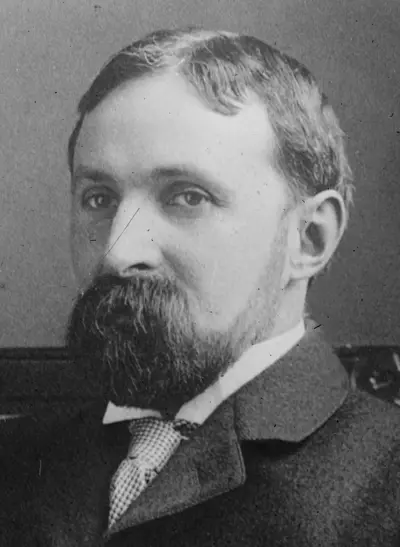
Albert Bushnell Hart was an American historian, writer, and editor based at Harvard University. One of the first generation of professionally trained historians in the United States, a prolific author and editor of historical works, Albert Bushnell Hart became, as Samuel Eliot Morison described him, "The Grand Old Man" of American history, looking the part with his "patriarchal full beard and flowing moustaches."
