Winston Churchill Quotes
At Washington I found the extraordinary significance if China in American minds. [It] accorded China almost equal fighting power with the British Empire and rated the Chinese [Nationalist] armies as a factor to be mentioned in the same breath and the armies of Russia. I told the President how much I felt American opinion overestimated the China would make to the general war. He differed strongly.
President Roosevelt had brilliantly judged the ability of England, Russia, and Yugoslavia to fight the Germans, but as this quotation and {641676} shows, he listened to the wrong people. He had been sold a “bill of goods” by the China Lobby, the Soongs and Chiang Kai-shek.
Winston Churchill, 1874-1965, British Prime Minister (Conservative), The Second Word War: The Hinge of Fate, 1950
Sourced by: Eigen's Political and Historical Quotations

Before American entry into the War with Japan, Chiang Kai-shek and the Soongs maintained that they were fighting the Japanese but it was not generally true. They were fighting Mao and his Communists while Mao was fighting the Japanese. By 1942, under pressure from the United States and Russia, the Nationalists and Communists agreed to a truce so that they could both fight against Japan. Based on the promises made to President Roosevelt by Madam Chiang, the Soongs, and Chiang himself, there was an expectation of extensive military attacks against the Japanese. The U. S. then sent a large amount of military aid to Chiang Kai-shek, but there did not appear to be any significant attacks against the Japanese other than those mounted by the Communists. Magruder, General Marshall’s emissary to Chiang Kai-shek was instructed to investigate. When the war ended, Chiang Kai-shek used the assets he was saving in to attack Mao and his communists just as he had done before the truce. Magruder had been right. However, just as Chiang could not defeat the militarily inferior Communists before the truce, he could not do so after. Soon Mao turned the tables and drove Chiang Kai-shek and his Nationalists out of Mainland China. President Roosevelt had brilliantly judged the ability of England, Russia, and Yugoslavia to fight the Germans, but as this quotation and {641677} shows, he listened to the wrong people. He had been sold a “bill of goods” by the China Lobby, the Soongs and Chiang Kai-shek.

In World War II, all the Chinese political organizations united to fight the Japanese invaders. The Communists however did most of the fighting and took the heaviest casualties. He proposed turning on their weakened allies and that was accepted by Chiang Kai-shek, the Nationalist leader. They attacked the Communists under Mao and Cho En Lai and forced them to flee across the country in the “Long March”. The Nationalists and their warlords were hated by the majority of the Chinese, especially the peasants who provided help and support to the Communists while they made their escape. They then regrouped and attacked the Nationalists in the Chinese Revolution and this time Chiang Kai-shek, Bai Chongxi and the other Chinese Leaders fled. With few people to help them, they had to flee to Taiwan, and the Communists took over China. Some historians believe that it was Chiang Kai-shek’s strategy all along to hold his soldiers back and let the Communists bear the casualties with the intention of turning on then when the Japanese were expelled. Others claim that Chiang’s relatively unaggressive military action against the Japanese reflected his typical conservatism and avoidance of risk and there was no intention to attack the Communists after the war and the alliance was made in good faith. Note that the leading Muslims in China (where they are a significant minority) were allied with the Chinese Christians against the Communists. Bai Chongxi had a special Muslim newspaper which regularly published religious quoted from the Koran and the Hadith purporting to support and justify Chiang Kai-shek, a Christian, as the rightful leader of China. This was another example of Islam being hijacked for a narrow political purpose. Also, note his use of the word “bandits”. This is a huge insult in the Chinese language culture. So of course the Nationalists used it to refer to the Communists—See {613286} .

Note that he assumes that not only will there be another World War, but he assumes that we will be on opposite sides.


3rd Earl Russell of Kingston. At the time China was one of the poorest nations on earth, with a series of feeble politicians and leaders fighting each other for the ability to rob the people. Their ancient science and virtues had been forgotten and it was thought of by the West and Asians alike as a failed state. However, Russell observed this one characteristic that could be so important when the rest of the world was learning more and more about everything from science to history. The search for wisdom from wherever it may be also gave them an advantage over other cultures who were more chauvinistic about the origin of whatever they did or thought. Less than a century later China was a superpower, economically, artistically intellectually, scientifically and almost militarily. It only lagged democratically.

This historic speech is regarded as one of the most important in Australia's history, marking a turning point in Australia's relationship with its founding country, the United Kingdom. Many felt that Prime Minister Curtin was abandoning Australia's traditional ties to the British Isles. -- Wikipedia


The allies had differences in desirable strategy alternatives. Russia was facing the German Army on its Eastern front and causing huge German casualties but were paying for them in large loss of Russian life—civilian and military (The Russians suffered 22 million deaths as a result of WWII.) Stalin wanted to open a second front in France which would force the Germans to move some divisions from the Russian front, thereby relieving some of the pressure.

The smaller German towns had not been targets for allied bombing and German censorship kept most Germans from realizing that the factories in the larger cities were being attacked. But the “rules of war” which the Germans had abandoned early in the war by bombing civilian targets in England and other European cities, required that only military targets be attacked. If a nation placed its factories or military bases in the midst of civilian populations, then the rules of war no longer protected the civilians. So the allies were within their rights by bombing the smaller towns where they targeted factories. However, this quotation is used by some critics to show that FDR’s motive was not the destruction of factories per se, but the breaking of German civilian morale. They argue that the allies were following the letter of the law, but not the spirit.

At Hamburg Harris organized a massive fire bombing of the German industrial city and the fire storm was so great that it sucked the oxygen out from huge sections of the city and thousands of people were roasted alive. Even with 100,000 Germans killed, Harris was convinced that it was a relatively humane way of waging a necessary war when compared to the classic artillery barrage followed by invading soldiers and street to street fighting.


Hopkins was a social worker with no military of political experience. But the President trusted him implicitly. Most American military officers and Ambassador to England Joseph P. Kennedy, a Nazi sympathizer & father of JFK, believed that England could not stand up to Hitler. Any military aid we gave England would fall into the hands of the Germans. Everyone was shocked when Roosevelt sent Hopkins to England to make a military recommendation. Hopkins, FDR’s closest advisor made this powerful and moving statement to Churchill and other British leaders. The combination of the first Biblical phrase with the second recognition of the possibility of failure, was inspirational for the British—just the effect Roosevelt sought.


During the American Revolution, conditions were very difficult for Washington’s soldiers who were ill armed, ill clothed, and ill fed while they were paid irregularly. At one point morale was so low that some of the soldiers revolted. Smyth observes that Washington and Congress disciplined the mutineers very mildly, especially when compared with the way the British would deal with such things. The British Governor Clinton tried to take advantage of the mutiny and the poor morale by announcing that all of Washington’s troops who wished could obtain amnesty and join the British forces where the pay and conditions were much better. Professor Smyth found it fascinating that none of the Americans would join the British and he credits it to the wise and mild discipline policies of Washington and Congress as well as the general perception of the justice of the American cause among the American troops.

This may have been one of the most indelicate and insensitive true public statements ever made by a politician. The English population and their political representatives were angry and worried very much that bombing of cities might become a German pattern (which it did.)

Germany had just attacked Russia with whom it had a treaty. For a while, Hitler paid little attention to Italy and just gave their “ally” orders and instructions. Italian public opinion was concerned about the same question. See {627973} .
3rd Earl Russell of Kingston. The military weak nations agreed with him, but the militarily strong ones did not—especially America and England which had the Atomic Bomb when others did not.
The Nazis occupied the cities, but the partisans survived in the mountains. The resistance was ferocious and very effective. From a German Soldier’s point of view, the Yugoslav front was the most dangerous assignment where his odds of being killed was even greater than the Russian front.

At the beginning of the Battle of Britain, it appeared that England would not be able to hold out against Germany. King was asked by Roosevelt to try and persuade British officials that if they sued for peace that they would not turn over the British fleet to the Germans but would convey it to Canada. Such an act would have produced serious retribution by the Germans.


This quotation illustrates an interesting characteristic of the British colonial military. The British military, under “Chinese Gordon” were assigned to help the government of the Empress Cixi put down a The Taiping Rebellion. However, the British army used just enough force to achieve the military objective, and would take prisoners and kill as few Chinese as possible. This was unsatisfactory to Earl Li who wanted all the rebels killed. His forces were not strong enough or brave enough to beat the rebels, but they were very adept at slaughtering defeated soldiers and their followers and supporters. Li, like most of the Chinese elite at the time, placed very little value on individual Chinese lives. However the fact that Gordon and his men did value individual Chinese lives highly impressed the Empress who was intent on modernizing China against the wishes of most of her court and nobility.
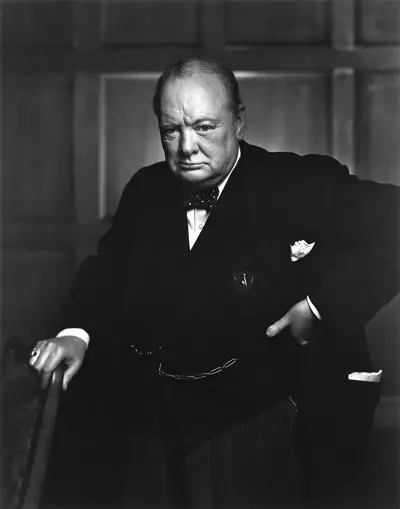
- Born: November 30, 1874
- Died: January 24, 1965
- Nationality: English
- Profession: Statesman
Sir Winston Leonard Spencer Churchill, KG, OM, CH, TD, DL, FRS, RA was the Prime Minister of the United Kingdom from 1940 to 1945, during the Second World War, and again from 1951 to 1955. Apart from two years between 1922 and 1924, Churchill was a Member of Parliament (MP) from 1900 to 1964 and represented a total of five constituencies. Ideologically an economic liberal and imperialist, he was for most of his career a member of the Conservative Party, as leader from 1940 to 1955. He was a member of the Liberal Party from 1904 to 1924. Churchill was also well known for his military career and as a historian, painter and writer, and among his many awards was the Nobel Prize in Literature.
