Winston Churchill Quotes
You ask what is our policy? I will say: It is to wage war, be sea, land, and air, with all our might and with all the strength that God can give us…. You ask, what is our aim? I can answer that in one word: It is victory, victory at all cost, victory in spite of all terror, victory no matter ho long and hard the road may be; for without victory, there is no survival.
Winston Churchill, 1874-1965, British Prime Minister (Conservative), Saint Crispin’s Day Speech after becoming Prime Minister, 1940
Sourced by: Eigen's Political and Historical Quotations


He has exactly right, but at the time there was much isolationist sentiment arguing against getting involved in “foreign wars”. To obtain the full industrial power of the United States, most of the manufacturing capability and raw materials would have to be taken from the civilian sector and devoted to military production. That would take men like Nelson, but primarily President Franklin Delano Roosevelt who would persuade the American people to make the immediate sacrifice to insure the future. See {642356} as an example.

The Americans had attacked the Belgian city of Brest and had been repulsed by a well fortified and led German contingent. Analysis of the wartime situation showed that Brest, a port city was no longer necessary for the Allied supplies as numerous other ports were taken and were available. Many of the officers wondered why Bradley wanted them to attack and defeat the Germans in Brest when all they had to do was surround them and eventually starve them out. Bradley’s response explained a subtle aspect of military and foreign policy. It is that the United States Army, once committed, will never be defeated or stopped. Had the Americans not already attempted to take Brest, they would not have bothered at this stage of the war, but since they had, it was imperative that they succeed. Otherwise, it was felt that Allies and enemies would not take future American threats as seriously and that the morale of American soldiers would even be affected if they thought they could be beaten. A similar problem occurred in the Vietnam War and later in the Iraq war. Once the short term military necessity of fighting was gone, the long-term factors came into play and often will. Others argue that the United States military is so strong and well equipped, that it no longer necessary to take casualties just to prove a psychological point.


Clovis did and the Romans were routed.

The Germans did not believe the British would send land troops. See {642105}.

Note that he assumes that not only will there be another World War, but he assumes that we will be on opposite sides.


This historic speech is regarded as one of the most important in Australia's history, marking a turning point in Australia's relationship with its founding country, the United Kingdom. Many felt that Prime Minister Curtin was abandoning Australia's traditional ties to the British Isles. -- Wikipedia


This is an interesting historical quotation because it shows how easily the United States commandeered private property during World War II. All it took was a letter from the Secretary of War. This particular quotation and letter had further historical significance. The school was acquired as the first facility for the Manhattan Project in Los Alamos. This was where the atomic bomb was built.

Soong's brothers-in-law were Dr. Sun Yat-sen and Generalissimo Chiang Kai-shek. He split with Chiang when he realized that Chiang was interested only of strengthening his power and fighting Mao and the Chinese Communists rather than the Japanese who occupied key parts of China. However, the Chinese had been fighting the Japanese for over 5 years and had while Japan occupied parts of Chine, they Japanese were still pinned down fighting the Chinese Communists, the American Volunteer Flying Tigers and occasional Chiang initiatives against the Japanese. Soong used the word democracy very liberally. China was divided between to power centers. Mao’s Communists and Chiang Kai-shek’s Nationalists. Both had “elections” but the Communists were a classic one party dictatorship of the left and Chiang was a classic dictator of the right. However, both were allies of the United States and enemies of Fascist Japan.

This speech was given in the early days of WWII when it was far from clear that we would win.

The Prime Minister, Neville Chamberlain, preceded him with the announcement of declaration of war against Germany, but it was left up to the Foreign Minister to explain the implications. This was the first time in history that a nation had used radio to communicate such momentous events to its population.

War and international conflict had become very complicated in modern times. Americans and most other people associated victory in war with unconditional surrender. However, since the unconditional surrender is of WWII, no conflict has ended with an unconditional surrender.
The Russians had lost over 20 million of its people to German WWII hostilities. They wanted a vengeance and were willing to take the casualties that came with the invasion of Berlin and many other key cities that were heavily defended. Eisenhower and Churchill realized that this would give the Russians a very dominant military occupation of Eastern Europe and Eastern Germany. However, they did not want to take the huge casualties of all these battles. Politically, Churchill and American leaders had to explain to their right wings why Russia was involved as an equal partner in making occupation decisions about Germany.

The histories and analyses of war have almost always been written by the victors. They naturally ascribe the victory to their, strategy, superiority, character and rightness of their cause—not to luck and fortune. Khaldun was one of the few, non modern historians to recognize luck as a major factor in war. That is one of the reasons he is so admired by modern scholars.


Hopkins was a social worker with no military of political experience. But the President trusted him implicitly. Most American military officers and Ambassador to England Joseph P. Kennedy, a Nazi sympathizer & father of JFK, believed that England could not stand up to Hitler. Any military aid we gave England would fall into the hands of the Germans. Everyone was shocked when Roosevelt sent Hopkins to England to make a military recommendation. To impress Hopkins with something he thought Hopkins would be interested in, Churchill led a tour of workers cottages built by the government. Hopkins surprised Churchill and his aids who would never forget this statement & then asked to see the military facilities. Hopkins distressed the American military by recommending that Britain could hold out against invasion if they received military aid. Despite the contrary military advice, FDR accepted Hopkins’ recommendations, and the rest is history. He had been right and much of the military wrong.


The automobile assembly lines of Detroit, had been planned to be converted to factories to produce a huge supply of planes, tanks, trucks and guns which were instrumental in winning the Second World War.
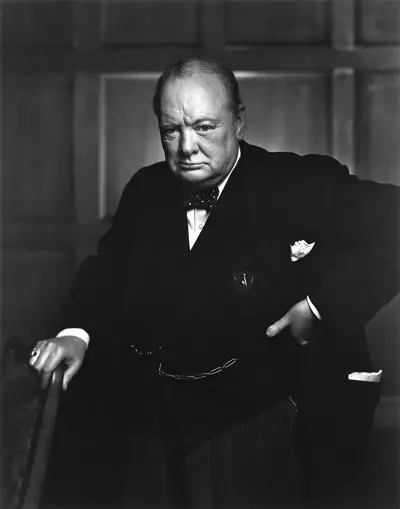
Sir Winston Leonard Spencer Churchill, KG, OM, CH, TD, DL, FRS, RA was the Prime Minister of the United Kingdom from 1940 to 1945, during the Second World War, and again from 1951 to 1955. Apart from two years between 1922 and 1924, Churchill was a Member of Parliament (MP) from 1900 to 1964 and represented a total of five constituencies. Ideologically an economic liberal and imperialist, he was for most of his career a member of the Conservative Party, as leader from 1940 to 1955. He was a member of the Liberal Party from 1904 to 1924. Churchill was also well known for his military career and as a historian, painter and writer, and among his many awards was the Nobel Prize in Literature.
