Omar N. Bradley Quotes
Any time we put our hand to a job we must finish it…. We must take Brest in order to maintain the illusion that the U. S. Army cannot be beaten.
The Americans had attacked the Belgian city of Brest and had been repulsed by a well fortified and led German contingent. Analysis of the wartime situation showed that Brest, a port city was no longer necessary for the Allied supplies as numerous other ports were taken and were available. Many of the officers wondered why Bradley wanted them to attack and defeat the Germans in Brest when all they had to do was surround them and eventually starve them out. Bradley’s response explained a subtle aspect of military and foreign policy. It is that the United States Army, once committed, will never be defeated or stopped. Had the Americans not already attempted to take Brest, they would not have bothered at this stage of the war, but since they had, it was imperative that they succeed. Otherwise, it was felt that Allies and enemies would not take future American threats as seriously and that the morale of American soldiers would even be affected if they thought they could be beaten. A similar problem occurred in the Vietnam War and later in the Iraq war. Once the short term military necessity of fighting was gone, the long-term factors came into play and often will. Others argue that the United States military is so strong and well equipped, that it no longer necessary to take casualties just to prove a psychological point.
Omar N. Bradley, 1893-1981, General of the Army, Permanent Chairman, Joint Chiefs of Staff, Conference with his General Officers, 1944
Sourced by: Eigen's Political and Historical Quotations


He was absolutely right, but Hitler paid him no heed. See {631290} for his suggested course for Germany.

Note that even then, De Gaulle’s nationalist ego focused not only on glory but glory that need not be shared. It was always a great strength and a great weakness for him. He and many French officers were so fixed on the glory of beating the Germans, that they did not focus on their ½ million casualties and were not prepared for the German countermeasures that turned the battle from a French victory to a long standoff and stalemate of the “Western Front” where neither side could advance much. Note also that De Gaulle failed to mention the British Expeditionary Force that twice saved the French from being overrun. Denial for the honor of France was always one of De Gaulle’s characteristics. See {642233} for the English commander’s view of the outcome of the Battle of the Marne.


1st Earl Lloyd-George of Dwyfor

The Muslims conquered Spain and controlled it to one extent or another for 600 years.

The smaller German towns had not been targets for allied bombing and German censorship kept most Germans from realizing that the factories in the larger cities were being attacked. But the “rules of war” which the Germans had abandoned early in the war by bombing civilian targets in England and other European cities, required that only military targets be attacked. If a nation placed its factories or military bases in the midst of civilian populations, then the rules of war no longer protected the civilians. So the allies were within their rights by bombing the smaller towns where they targeted factories. However, this quotation is used by some critics to show that FDR’s motive was not the destruction of factories per se, but the breaking of German civilian morale. They argue that the allies were following the letter of the law, but not the spirit.

Note that he assumes that not only will there be another World War, but he assumes that we will be on opposite sides.
Soong's brothers-in-law were Dr. Sun Yat-sen and Generalissimo Chiang Kai-shek. He split with Chiang when he realized that Chiang was interested only of strengthening his power and fighting Mao and the Chinese Communists rather than the Japanese who occupied key parts of China. However, the Chinese had been fighting the Japanese for over 5 years and had while Japan occupied parts of Chine, they Japanese were still pinned down fighting the Chinese Communists, the American Volunteer Flying Tigers and occasional Chiang initiatives against the Japanese. Soong used the word democracy very liberally. China was divided between to power centers. Mao’s Communists and Chiang Kai-shek’s Nationalists. Both had “elections” but the Communists were a classic one party dictatorship of the left and Chiang was a classic dictator of the right. However, both were allies of the United States and enemies of Fascist Japan.

In World War II, all the Chinese political organizations united to fight the Japanese invaders. The Communists however did most of the fighting and took the heaviest casualties. He proposed turning on their weakened allies and that was accepted by Chiang Kai-shek, the Nationalist leader. They attacked the Communists under Mao and Cho En Lai and forced them to flee across the country in the “Long March”. The Nationalists and their warlords were hated by the majority of the Chinese, especially the peasants who provided help and support to the Communists while they made their escape. They then regrouped and attacked the Nationalists in the Chinese Revolution and this time Chiang Kai-shek, Bai Chongxi and the other Chinese Leaders fled. With few people to help them, they had to flee to Taiwan, and the Communists took over China. Some historians believe that it was Chiang Kai-shek’s strategy all along to hold his soldiers back and let the Communists bear the casualties with the intention of turning on then when the Japanese were expelled. Others claim that Chiang’s relatively unaggressive military action against the Japanese reflected his typical conservatism and avoidance of risk and there was no intention to attack the Communists after the war and the alliance was made in good faith. Note that the leading Muslims in China (where they are a significant minority) were allied with the Chinese Christians against the Communists. Bai Chongxi had a special Muslim newspaper which regularly published religious quoted from the Koran and the Hadith purporting to support and justify Chiang Kai-shek, a Christian, as the rightful leader of China. This was another example of Islam being hijacked for a narrow political purpose. Also, note his use of the word “bandits”. This is a huge insult in the Chinese language culture. So of course the Nationalists used it to refer to the Communists—See {613286} .

He always appeared in a military uniform after that.


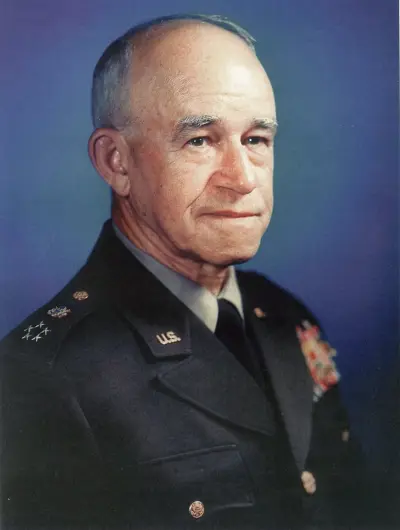
Omar Nelson Bradley was a senior officer of the United States Army during and after World War II, holding the rank of General of the Army. Bradley was the first Chairman of the Joint Chiefs of Staff and oversaw the U.S. military's policy-making in the Korean War.
