Reinhard Scheer Quotes
An honorable battle, even if it is a fight to the finish, will sow the seeds of a great new German fleet.
The German naval command—without the permission of the Kaiser—at the eve of a losing war decided that the entire German navy would make a grand attack against the far superior English fleet. It was to be a virtual suicide attack on a grand scale. However, most German sailors heard about the plan and refused orders to attack in what was the largest mutiny in history. The German naval leaders then took the fleet out to sea and scuttled all the ships so that the English would not capture them. The result was the same but tens of thousands of lives were saved; many German officers felt that German naval honor had been lost.
Reinhard Scheer, 1863-1928, German Admiral, Statement to the German sailors at the end of WWI
Sourced by: Eigen's Political and Historical Quotations

This quotation illustrated a military phenomenon whereby leading military commanders are important as long as they have and control many military assets. Therefore, they avoid serious battles where the might lose. Preserving assets becomes more important than the war objectives and honor and reputation trumps contribution to the war effort. History remembers well military leaders who battle and win. It also remembers leaders who control many assets and who do not lose or win. But the losing military leaders are consigned to the “dustbin of history”.

Military men tend to rely so much on military history that they are almost always fighting the last war. Soon air power would supplant sea power as the critical factor. Then nuclear power, and then nuclear weapons became too severe for actual use and yet wars still continued with no consensus as to that will be in the future.

Germany had a very small and insignificant navy. It was Tirpitz who persuaded the nation to develop sea power.


He didn’t succeed until Mahan wrote his marvelous treatise.


He was referring to attacking the Barbary States. The Barbary Pirates had an incredible extortion racket going in the Mediterranean. If nations would pay them an annual sum each year, they would not attack and seize merchant ships of that country and sell the ships and goods while holding the sailors for ransom. See {640846}.

In the first year of WWI, the British Fleet kept the German Fleet bottled up in port. As a result, the British had a very successful sea embargo against the Germans who rarely challenged the British fleet even though they had some major, powerful, capital ships. See {642234}. Meanwhile, the German ships were in no position to harass much less destroy Allied (French, Russian or English) shipping.


1st Earl Lloyd-George of Dwyfor

Koxinga had an overwhelmingly superior force, and wanted the Dutch to surrender and avoid bloodshed. The Dutch with their typical European colonial attitude, had great difficulty surrendering to “natives” even if outnumbered. Finally, the Dutch Commander agreed to surrender. Koxinga then established a Chinese Government on the Island and became a great hero of the Ming Dynasty. Note the graphic of the statue to him which is one of the very few Chinese memorial statues to a military hero showing him in action—very similar to European statues. Already Koxinga’s massed wooden junks with small cannon and fire torches had sunk one of the Dutch warships (they were not iron but had some iron plates on the deck to protect the gunners) and there were so many junks that the other Dutch ships sailed out to sea to avoid the Chinese huge number of junks.


The Germans did not believe the British would send land troops. See {642105}.

The Times regretted that the Germans did not speak to the Austrians more vigorously when they were threatening to attack Serbia who harbored anti-Austro-Hungarian terrorists (see {642085}). What the Times editors did not realize was that the Germans had already made their war plans (see {642092}) and the Serbian issue was just the justification they needed to implement them. So there was no real reason for the Germans to discourage the Austro-Hungarian Empire from its mission to punish Serbia.

The Boers had just a few years before lost their war with the British who were then in control of South Africa. However, the British did not treat the Boers harshly in defeat and most Boers were at the time farmers and land owners who were a major force in democratic South Africa and had much invested in the nation. Others were still resentful of the British. The Boers sided with the British and fought the Germans who had troops and colonies in Africa. Like the Irish, culturally, they were always up for a good fight.
English foreign and military policy had been so effective that English citizens had been completely sheltered from all the British military hostilities throughout the world. Keyserlingk and other German military planners, observing the effect that home public opinion had on war policies and practices, placed a high priority on bringing war to the British civilians and sinking merchant ships was the one way they had technologically open to them. Latter, in WWII, the same objective was achieved by the bombing of the Blitz—bombing of London and other cities with planes and rockets.


Dreadnoughts were huge battleships. Britain had the dominant navy of the world and controlled the seas. A European war would be a land war where a navy would be of little use. Hence, Britain would not want to get involved in such a war where she could not use her greatest military strength. He was wrong about this and so much else. Britain entered WWI when Germany invaded Belgium fulfilling her treaty obligations. The Germans intelligence operators and analysts were well aware of the treaty obligations, but had little understanding of English culture and tradition. The German aggression against a small power like Belgium was morally offensive to many in Great Britain, and Britain had a tradition of fighting for moral principles. The Germans would never militarily disadvantage themselves for the sake of a treaty obligation to a small nation, and they did not believe that the British would be so different and fulfill their treaty obligations even though their strongest military asset—their navy would not be very helpful.
The War Plan that the Germans had developed--{642092}—had gone awry at the battle of the Marne in late 1914.
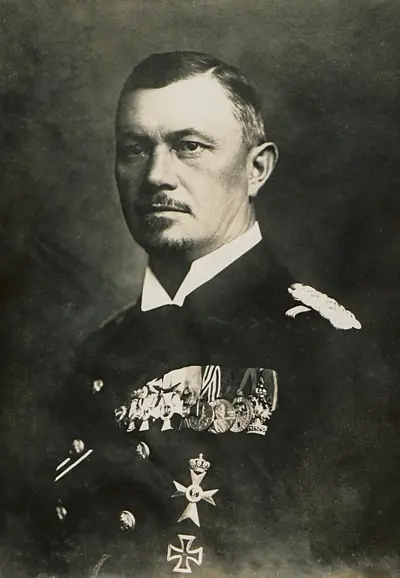
Carl Friedrich Heinrich Reinhard Scheer was an Admiral in the Imperial German Navy (Kaiserliche Marine). Scheer joined the navy in 1879 as an officer cadet and progressed through the ranks, commanding cruisers and battleships, as well as senior staff positions on land. At the outbreak of World War I, Scheer was the commander of the II Battle Squadron of the High Seas Fleet. He then took command of the III Battle Squadron, which consisted of the newest and most powerful battleships in the navy. In January 1916, he was promoted to Admiral and given control of the High Seas Fleet. Scheer led the German fleet at the Battle of Jutland on 31 May – 1 June 1916, one of the largest naval battles in history.
