Samuel Johnson Quotes
Agriculture not only gives riches to a nation, but the only riches she can call her own.
Johnson, Samuel. "Further Thoughts on Agriculture." The Universal Visiter, 1756.


Inscribed in the South Lunette of the Library of Congress

While this was somewhat hyperbolic at the time, it became true during the century.


Actually, Kerry was incorrect, but he had a point, There are about 110,000 employees of the U. S. Department of Agriculture and every state has their own department of Agriculture with employees. There are about 2 million farms in America. So there is a government agriculture employee for about every 15 farms—a ratio that no other occupation shares.

She advocates cutting out more of the middle men in the food chain and having the farmer earn more money. One difficulty with her idea is that the vast majority of farming today is done by large corporations who are already making a good deal of money and consumer groups do not want to further enrich these corporations at the expense of the consumer. However by buying directly from the small farmer who grows particularly good food, she can accomplish the objective on a small scale.

Environmentalists counter with the fact that the corporate and government interests in growth at any cost will, and have in the past, found a loophole in every reasonable compromise that has been made. Reasonableness is only a device they use to slow regulation until they can either figure out a loophole or use their great fiscal resources to shape public thinking to soften or eliminate the regulation. Therefore some environments argue that they must be as ideological about the environment as the corporations are about their rights to profit and not compromise even when a compromise appears reasonable. Besides, if the corporations always appear to win, the public will think opposing them is futile. So when they can be beaten on something that is unreasonable, they appear weaker and encourage more environmental public activism.


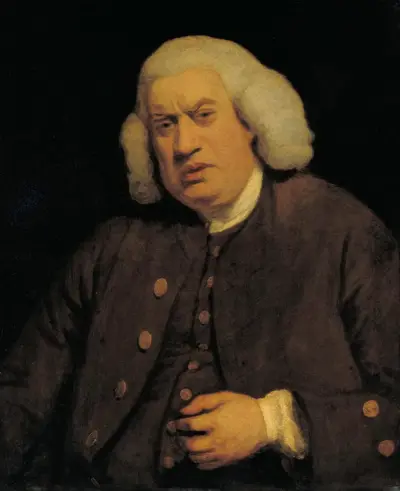
Samuel Johnson, often referred to as Dr Johnson, was an English writer who made lasting contributions to English literature as a poet, playwright, essayist, moralist, literary critic, biographer, editor, and lexicographer. Religiously, he was a devout Anglican, and politically a committed Tory. The Oxford Dictionary of National Biography describes Johnson as "arguably the most distinguished man of letters in English history". He is the subject of James Boswell's The Life of Samuel Johnson, described by Walter Jackson Bate as "the most famous single work of biographical art in the whole of literature".
