Nguyen Cao Ky Quotes
After the 1954 Geneva international conference, Vietnam was divided into two parts. On paper, North and South Vietnam were twin countries born at the same moment.
Ky, Nguyen Cao. Twenty Years and Twenty Days. Stein and Day, 1976.


The first has already occurred; the second is still an open question.


Nguyen Vinh Thuy. and correct prediction


Chomsky was not asserting this statement as the truth. He was making the statement assuming that the absurdity of it would be clear to the listener and they would also realize that was what the then government policy was. North Vietnamese had infiltrated the South and had much support in many of the South Vietnamese villages. When the U. S. bombed the North Vietnamese—and the Vietnamese inhabitants—of those villages, the intention was indeed to help the South Vietnamese. If Chomsky were a politician running for office, his opponent might well have taken this quote and used it to “prove” that Chomsky supported the American effort in the Vietnam War when he was a vehement opponent.


King had just publicly advocated the UN seating of Red China. The negative reaction from politicians who were friends of the Civil Rights Movement was just what Levison was worried about – see {637661}.

Up to that time U. S. policy was to provide training and assistance to the South Vietnamese government and military, but not to attack the North. America had backed a corrupt and incompetent South Vietnamese government and Bundy and other policy makers were convinced that the North Vietnam would win, if the fighting and governing were solely left to the South Vietnamese. Johnson, who had resisted this policy for several weeks finally acceded. It was a major escalation of the Vietnam War.


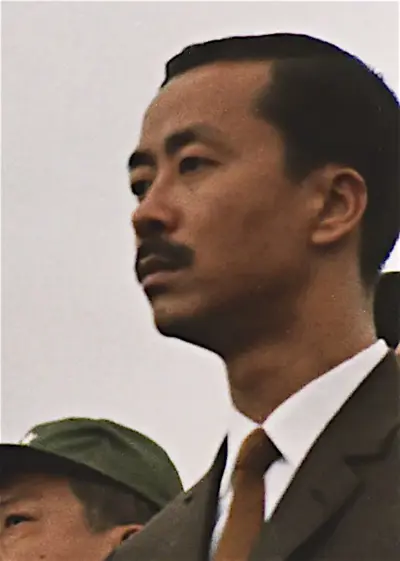
Nguyễn Cao Kỳ was a Vietnamese military officer and politician who served as the chief of the Republic of Vietnam Air Force in the 1960s, before leading the nation as the prime minister of South Vietnam in a military junta from 1965 to 1967. Then, until his retirement from politics in 1971, he served as vice president to bitter rival General Nguyễn Văn Thiệu, in a nominally civilian administration.
