Allen C. Guelzo Quotes
Abraham Lincoln would have been happy to have solved the slavery problem by compensation - in fact, drew up a gradual, compensated emancipation plan as early as November, 1861 - but no slaveholders were willing to go along with it.
Guelzo, Allen C. "Lincoln and Douglas: The Debates That Defined America." The Washington Post, 12 Feb. 2008.


At the time, the prevailing federal policy was to return fugitive slaves to their owners. Lincoln was intent on keeping Kentucky and Maryland, both slave states, in the union, even at the cost of returning fugitive slaves. Shortly after, he came up with the policy of always returning fugitive slaves except in the rebellious states of the confederacy where the slaves were legally defined as ‘contraband’—war material, and thus could be seized by Union forces. Many fugitive slaves were thus employed by the Union for construction projects. Later, the Emancipation Proclamation set the slaves of the Confederacy free.


See Mark {606304}; also Matthew {606727}. Lincoln had used the “house divided” biblical metaphor in 1843 when arguing for Whig solidarity. The first political use of the Biblical metaphor and quotation with respect to American slavery appears to have been by Sam Houston in 1850 {603970}. The first use with respect to American slavery was byMassachusetts abolitionist, Edmund Quincy, in 1852. The second sentence of this famous quotation was forsaged earlier. See Lincoln, {619494} & {584918}. Also See Felix Rohatyn who used the Lincoln line to refer to poverty: {70611}.


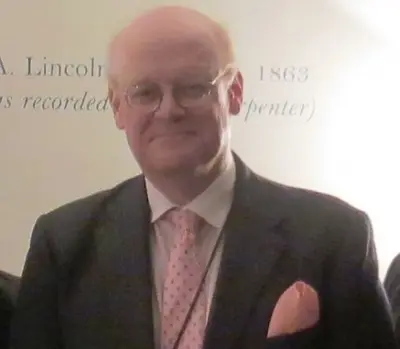
Allen Carl Guelzo (born 1953) is an American historian who serves as Senior Research Scholar in the Council of the Humanities and Director of the Initiative on Politics and Statesmanship in the James Madison Program at Princeton University. He formerly was a professor of History at Getttysburg College.
