Mohammed Reza Pahlavi Quotes
A person who does not enter the new party [The Shah’s Party]... is either an individual who belongs to an illegal organization, or is related to the outlaw Tudeh Party, or in other words is a traitor. Such an individual belongs in an Iranian prison, or if he desires, he can leave the country tomorrow... because he is not an Iranian, he has no nation, and his activities are illegal and punishable according to law.
Mohammed Reza Pahlavi, 1919-1980, Shah of Iran, Quoted in Marvin Zonis, Majestic Failure: The Fall of the Shah, 1991
Sourced by: Eigen's Political and Historical Quotations


Ivan the Terrible. He was referring to himself as God’s Chosen One. He and the Church were aligned against the Nobles, whose lands Ivan wanted. He would execute hundreds of “traitors” every month. He even executed the families of his enemies in very cruel ways. He claimed to be “cleansing” the land of sinners in preparation for the coming judgment day, and the church backed him up on this. The Church gave him carte blanche to “punish” all sinners and his paranoia eventually got around to the church fathers themselves who became the final victims.

The War of 1812 produced the first “peace movement” in the United States. The transgressions against our ships on the part of the French were much greater than those of the English who each accused us of trading with their enemy and ignoring their blockade. Nonetheless we want to war against England. Meanwhile, New England and some New York farmers and merchants were supplying not only English Canada with food and merchandise including supplying the British Army in Canada, which was not against the law then even in wartime. The “Western Frontier” in contrast were strongly in favor of the war, as they had expansionist designs on invading Canada and resented the British for supplying and allying with the Indian Tribes that were resisting the white expansion into their territories and frequently attacked and massacred farmers on the frontiers of Pennsylvania, Ohio, Virginia, Kentucky, Maryland, and the Carolinas. Morse wanted to hang opponents of the war.

Trump was then President Elect who already had a large staff helping him fomake the transition. He still went off on his own with this state,ment whiich runs afoul of the Constitution which he would soon sware to defend when he took the Oath of Office. The Supreme Court had unequivocably ruled that the burning of the flag was a type of political speech and as such could not be curtailed or punished by the government. The penalty of a loss of citizenship was another constitutional thicket. In addition. in the hisoty of the country,, it had never been used as a punishment for breaking domestic law.

Referring to the Erdogan government of Turkey. That country elected Erdogan who then turned his back on the Ataturk inspired democracy and instituted many non-democratic policies and practices including jailing civil servants, teachers and journalists who publicly criticize the president or the government.


The Stalinist purges were all foretold by this bloody toast which was attended by many of the Soviet leaders.


One of their friends was then Judge Stephen Douglas who advocated equality for Mormons and appointed Mormons to various posts. Mormon support helped the Democrat’s Thomas L. Ford win the next gubernatorial race over his Whig opponent who was virulently anti-Mormon.

This is the most formalized and sophisticated compendium of laws of the so-called “barbaric peoples” of Europe. The compilation was in many ways a documentation of the traditional laws of the Visigoths that had evolved over hundreds of years.

The strongman President of Egypt promised the he would lift the martial law after the last election 6 years before. He did not. Under Mubarach. Egypt has had martial law for 30 years.


With so many revolutionary rulers of new nations suppressing all opposition, the history of Ataturk and Turkey is unique. Ataturk was so popular and his People’s Party so successful that there was no opposition and Turkey had one party rule. However, Ataturk was determined to have Turkey become a parliamentary democracy as good as the Western nations of Europe. So a tradition of multi-party democracy was needed. So Ataturk actually went to his friend Fethi Okyar and asked him to start an opposition party and oppose the government. Fethi was a strong supporter of the revolution and generally was in concurrence with Ataturk and the People’s Party on everything. Ataturk however convinced him that they had to start a tradition that would take Turkey through the future, and he did create a new party-- Serbest Cumhuriyet Fırkası (Liberal Republican Party) and worked hard to find differences with the People’s Party and the Government. One immediate contribution was the oversight that the new party provided—a strong tradition that exists to this day in Turkey.

At the time, the dependence on Saudi oil inhibited American criticism . This began to change in the 21st century.

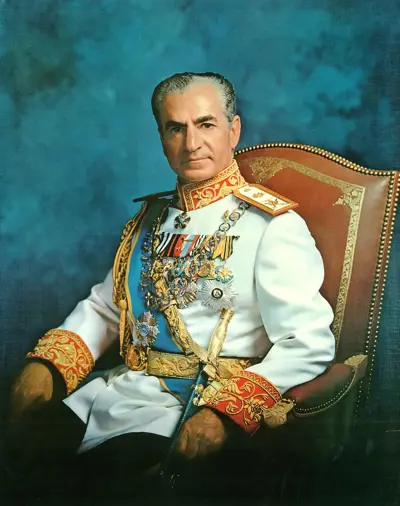
Mohammad Reza Pahlavi, also known as Mohammad Reza Shah (محمدرضا شاه), was the last Shah (King) of Iran from 16 September 1941 until his overthrow in the Iranian Revolution on 11 February 1979. Due to his status as the last Shah of Iran, he is often known as simply the Shah.
