Joseph Stalin Quotes
We have unified the state in such a way that if any part were isolated from the common socialist state, it would not only inflict harm on the latter but would be unable to exist independently and would inevitably fall under foreign subjugation. Therefore, whoever attempts to destroy the socialist state … is an enemy, a sworn enemy of the state and of the peoples of the USSR. And we will destroy each and every such enemy, even if he is an old Bolshevik; we will destroy all his kin; we will mercilessly destroy anyone who by his deeds or his thoughts—threatens the unity of this socialist state. To the complete destruction of all enemies, themselves and their kin.
The Stalinist purges were all foretold by this bloody toast which was attended by many of the Soviet leaders.
Joseph Stalin, 1879-1953, Russian Premier, Toast, Home of Marshal Kliment Voroshilov, November 7, 1937 [Revolution Day]
Sourced by: Eigen's Political and Historical Quotations

Stalin’s purges and suppression of potential rivals killed off mostly other communists exceeding the number of communists killed by brutal, murderous, anti-communist forces over the world.
1st Viscountess Snowden. See Winston Churchill regarding the most famous use of the “iron curtain” phrase {411311}. She seems to have been an earlier user. The phrase " iron curtain" was used by T. St. Vincent Wallace Troubridge a few months earlier than Churchill. Also, it appears to have been used earlier than that by Nazi Propaganda Minister Joseph Goebbels in Das Reich {601664}. But George Washington Crile used the phrase in a political context in 1915 {598870}. And Viscountess Snowden used the phrase in her memoirs of a Past WWI trip to Russia {616546}. It is not known whether Troubridge or Churchill were familiar with any of these other works.


The one area where communists were successful was in fighting for the Russian Homeland in WWII and the subsequent assault on Germany from the East. Most American military experts did not believe that the Russians could hold out. However with American weapons and supplies they proved most effective in causing German casualties. The Russians, however, had lost 22 million soldiers and civilians—a fearful cost. But the Communists proved they could lead a nation at war, and this success bought them 50 years of acceptance from the Russian people before their inability to manage a civilian society finally became clear and the Soviet Union collapsed.


Even leading Soviet officials were critical of the Stalin era and Stalin’s brutal, dictatorial methods.

This was a very important quotation in that Sartre was a very influential liberal philosopher and when he condemned Russian communism, many other liberals opposed communism, and those who had already felt vindicated in their decision.
This was a big factor that made the Red Scare so damaging.


Harriman at that time was the United States Ambassador to Russia and one of President Roosevelt’s closest advisers. There were those who claimed that the Roosevelt administration was very naïve about the potential danger of Stalin. This statement as well as others like it, show that the administration was not so naïve and ignorant.


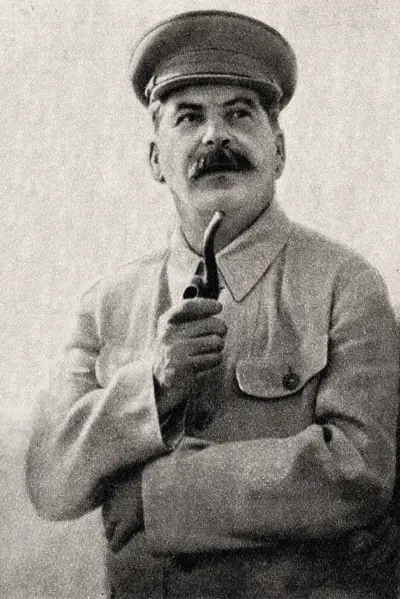
Joseph Vissarionovich Stalin was a Georgian revolutionary and the ruler of the Soviet Union from 1927 until 1953. He served as both General Secretary of the Communist Party of the Soviet Union (1922–1952) and Chairman of the Council of Ministers of the Soviet Union (1941–1953). Despite initially governing the country as part of a collective leadership, he ultimately consolidated power to become the Soviet Union's de facto dictator by the 1930s. A communist ideologically committed to the Leninist interpretation of Marxism, Stalin formalized these ideas as Marxism–Leninism while his own policies are known as Stalinism.
