Maajid Nawaz Quotes
A fatwa is a religious edict. Such edicts bind only those who seek to follow the Imam issuing them but can be regarded as an option for others seeking an alternative view.
Nawaz, Maajid. Radical: My Journey out of Islamist Extremism. Lyons Press, 2013.

The letter had been written earlier, but this and 51 other letters written when she was in Turkey were published in 1763. At the time, Turkey, the seat of the Ottoman Empire, was an Islamic state operating under Islamic law, as were all countries within the Ottoman Empire. Today, Turkey is a secular state and the clergy and the legal profession are separate.

Theological & Legal Expert. The Sunnah, like the Koran, has statements of the Prophet, Mohammad. A fatwa is a religious legal ruling. This particular Fatwa shows the great difference between the Islamic State and a Republic or Democracy. In the latter forms, any religious practices must be consistent with the Constitution. Even though blasphemy might be prohibited by a religion, the United States Constitution for example protects anyone’s right to be blasphemous. In the Islamic system any constitution or law is subservient to and must be consistent with, the sayings of the Prophet Muhammad. In that sense, unless the Muslim populated nation is secular like Turkey, then the governments are partial or total theocracies.


In an orthodox Muslim nation, freedom of speech as a right is impossible.
The Messenger is Muhammed, founder of Islam. The Hadith are his sayings which have been compiled but are not in the Koran.
The last Caliph of the Muslims was removed in 1924 as part of the Turkish Reform. The position has had attraction for many Muslim leaders who saw themselves in the role, but since 1924, nationalism and modernism and the lack of an effective international Muslim leader has precluded it. This anti-revolutionary sentiment of the Islamic political state that is so traditional, may in part account for the Islamic tolerance of autocratic regimes. Note that the distinction between religious responsibilities and civil are important. Tyranny must be tolerated but not blasphemy or heresy. Traditional Muslims provide more tolerance and forbearance for a leader’s civil failings than religious. But Muslims were not the only people to do this. A British prime minister had a view with the same conservative logic. See {639130}. The ancient Jewish Macabean revolt against the Jewish king was all based on failure to perform required religious duties of sacrifice as opposed to tyranny and poor government which also existed. Popes excommunicated Kings for religious reasons, not because of their civil failures at governing. Holding rulers accountable for civil performance is a relatively new concept yet is indispensible in a modern democracy.


This is a very important point as most Muslims believe that the actual wording of the Sharia—Islamic Law—comes from the Prophet directly and are not the words of various legal scholars which is just what they are. Needless to say, there are many differences and even contradictions depending on time and the particular scholar. Islam however has no authority that religiously is higher than any other. In that respect, it is like Judaism. There is not a recognized religious hierarchy as there is in Christian churches.

A fatwa is a legal / theological ruling or decision made by an Islamic legal expert. Many disagree with each other just as American legal opinions often disagree.


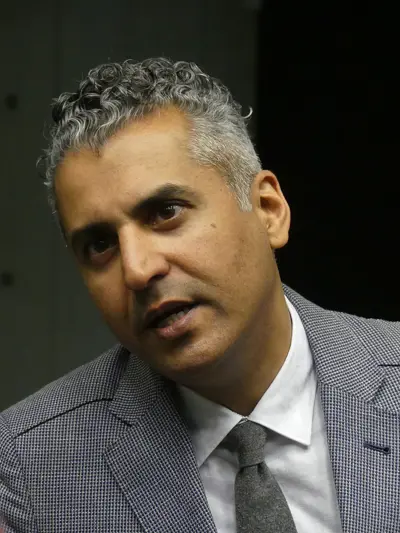
Maajid Usman Nawaz is a British activist and radio presenter. He is the founding chairman of Quilliam, a counter-extremism think tank that seeks to challenge the narratives of Islamist extremists, and the host of a radio show on LBC, every Saturday and Sunday.
