Commission on the Intelligence Capabilities of the United States regarding Weapons of Mass Destruction Quotes
… a closed world. … an almost perfect record of resisting change. … fragmented, loosely managed, and poorly coordinated. … often unable to gather intelligence about the things we care the most about. … analysts do not always tell the decision makers just how limited their information really is. … increasingly irrelevant to the new challenges presented by weapons of mass destruction. … espionage is always chancy at best. Still we have no choice but to do better.
Silberman-Robb WMD Commission
Commission on the Intelligence Capabilities of the United States regarding Weapons of Mass Destruction, ., Presidential Investigative Commission
Sourced by: Eigen's Political and Historical Quotations


Kay was chasing around Iraq trying to find the weapons that the George W. Bush administration had said definitely existed. Based on the weapons existence, the United States went to War in Iraq. No weapons were ever found.

His concern was well placed. For over half a century thereafter, the tail did wag the dog, and while there have been many successful covert operations, the risk and current pressure siphoned off talent and management attention from intelligence—the Central Intelligence Agency’s primary job.
The scandals of the past of CIA lies to Congress and the President, mistakes they had made, and a raft of illegal activities, had eroded support for the agency. We still had the NSA and the Military Intelligence Agencies which had not been involved in the CIA scandals.


He was appointed by President Nixon to head a "blue ribbon panel" to review the Department of Defense, and announced the conclusions:


It is noteworthy that a U. S. President had such a harsh evaluation of our major intelligence agency. Even more important in this case is that this President justified his 2003 decision to invade Iraq and start the war on the intelligence he claimed was provided to him by the CIA that Iraq had weapons of mass destruction. This quotation and the President’s view was not public at the time. I all fairness to the CIA staff, many of them had provided a number of caveats and warnings about the unreliability of the information. However, the CIA Director, George Tenant, advised Bush in a way that the caveats were sublimated. See {633093} for more detail.

This quotation comes as a major surprise to most people who perceive modern CIA as the MAJOR U.S. spying and covert action organization. It is a marvelous case study of agency “mission creep”.

Dulles was a master of fending off calls for CIA reform. In this case he pretended to look for another agency to take over covert operations, but found in each case that they could not keep secrets well enough. In the 21st century, the CIA was still handling covert operations and have relinquished nothing.

even though in this case the objective The State Department, the Defense Department and most important President Kennedy had decided to get rid of Diem. Most of the Central Intelligence Agency thought that this was a very unwise policy, because Diem was a known risk, and the people who would replace him and their talents and policies were unknown. The negatives of Diem—the facts that he, a Christian, was persecuting the majority Buddhists, was totally corrupt, and not a very good leader was less distressful to the CIA than to the President and the other agencies as the intelligence agency frequently not only tolerated “offensive” allies, but actually employed them including war criminals. Another importance of this quotation is that it shows that it was by no means certain that the CIA would always follow the orders of the President and the government policy makers. Colby, who was not the agency director at that time but was the head of the South East Bureau, was one high level official who argued that the policies should always be followed even if they were unwise or foolish. Another importance of this quotation is that it illustrate a common error that administrations are frequently forced to make: making a policy decision to eliminate a problem while not having much of an idea of what the alternative or consequence would be when the policy is implemented. The Syrian Civil War in 2013 was a good example. The Government side appeared to have used Chemical Warfare on Civilians and public opinion demanded that we do something. However, having a no-fly zone or any of the alternatives to prevent (punish) the government for the Chemical Warfare would strengthen the rebel side which was made up of numerous factions—some of which were known Islamic fundamentalist terrorists and jihadists. If the balance of power were tipped toward the rebels, the consequence for the American national interests were unknown—just as the consequence of ousting Diem was unknown and turned out to also be bad and was probably worse.

This was meant as a criticism of Webster, but must people saw it as a compliment. What Clarridge and other old hands at the CIA could never get straight was that they were supposed to break the other countries’ laws but not the laws of the United States. They were supposed to lie to other countries, but not to our President and Congress. This has been a constant problem for United States intelligence agencies. Some scholars of espionage believe that a good spy or spy master lies so often that it is part of his nature to do so as well as break laws. Psychologically it is difficult for them not to lie to anyone and they have little respect for laws. Webster fired Clarridge when Webster reformed the CIA but in the process he alienated most of the “veterans”.
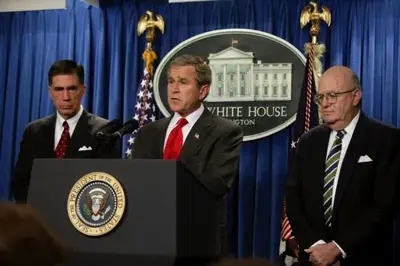
The Commission on the Intelligence Capabilities of the United States Regarding Weapons of Mass Destruction is a panel created by Executive Order 13328, signed by U.S. President George W. Bush in February 2004. The impetus for the Commission lay with a public controversy occasioned by statements, including those of Chief of the Iraq Survey Group, David Kay, that the Intelligence Community had grossly erred in judging that Iraq had been developing weapons of mass destruction (WMD) before the March 2003 start of Operation Iraqi Freedom. President Bush therefore formed the Commission, but gave it a broad mandate not only to look into any errors behind the Iraq intelligence, but also to look into intelligence on WMD programs in Afghanistan and Libya, as well as to examine the capabilities of the Intelligence Community to address the problem of WMD proliferation and "related threats." However, the commission was not directed to examine the extent to which the Bush administration may have manipulated the intelligence.
