Francis E. Townsend Quotes
$30 Every Thursday
In the midst of the Great Depression, Townsend had organized millions of Americans into “Townsend Clubs” to save money for their old age retirement. Townsend had proposed that the Government should run such a program where workers paid in every week and then all who were retired or disabled received $30 a week for like. There was no national pension plan at the time. When Townsend together with two right wing religious extremists formed the Union Party, the one vulnerability that the Roosevelt Administration felt it had was the lack of an old-age pension plan. Within a few days, Roosevelt proposed a new plan of the New Deal to Congress. It was called Social Security. It passed in record time.
Francis E. Townsend, 1867-1960, Physician & Founder, Old Age Revolving Pensions, Co-founder, Union Party, Slogan for his Pension Plan
Sourced by: Eigen's Political and Historical Quotations


FDR was terribly affable and was at the opposite end of the spectrum from the ideologues. Therefore he never offered specific programs. He was this grossly underestimated by many of the pundits of the day as being shallow with few or no ideas. Actually, he implemented more new ideas and programs than any other President in history but was very pragmatic about them and not really wedded to any of them. If one thing did not work, he tried another. The people and the Congress grew to trust him as no other president in our history although he always had his right wing enemies.

At the end of the 19th century, there were no private pensions for industrial workers nor was their A Social Security system of any other provision for retirement as workers age. Nor was their any Medicare or welfare system then established. Gompers’ description was then accurate.

This statement was quoted over and over by his Presidential opponent, Lyndon Johnson in the campaign of 1964. Although, a wealthy person could on the average do a little better with a private investment of equivalent money and a disability insurance, those citizens of less wealth could not do so as easily. And few could obtain the disability and survivor benefits that comes along with Social Security. Goldwater wanted to make Social Security Voluntary, and most Americans thought the Goldwater prescription for Social Security would kill the program and did not support him. Conservatives have argued for this idea ever since, including Geirge W. Bush who made it a centerpiece of his administration’s program. It was rejected by the voters, and most of those were proven right when with the 2008 stocks had lost 50% of their value—the people who had retired and depended on their return from investments were mostly in terrible trouble. And of course, even in good times, some people who invest in the stock and bond markets do well and some do poorly. What would society do about those who lost most of their retirement. Let them starve because they invested badly?

She was also Australia’s First Woman Cabinet Minister.

Hoover, a brilliant administrator before his presidency, was so ideological about the role of government that when the Great Depression came, he was unwilling to use government directly to cope with the new problems. He was turned out of office in favor of FDR and the New Deal which the voters ratified 4 times. Hoover was embarrassed by the New Deal successes and lashed out with many insults. In this case, he called the New Deal “fascist”. See {629055} for another quote where he labels the New Deal communistic. Ironically, Hoover is rated by most historians as one of the least effective Presidents in American history while Roosevelt is always rated among the top 3 presidents.


Hope cracked this joke after Franklin Delano Roosevelt was elected for an unprecedented fourth term as president:


The Supreme Court which had found many of the New Deal laws unconstitutional, saw no Constitutional Problem with Social Security. However, the most popular legislation in American history had many right wing and in this case Fascist opponents. The Sentinels of the Republic was a group of wealthy right wing extremists who opposed FDR and all his programs of which Social Security was the most important. See {620798}.

The minimum wage has never come close to meeting this ideal criterion in any country of the world. At the same time, health insurance costs in the U. S. and some other countries has been increasing at a much greater rate than wages, making this ideal situation even more unattainable.


The lead paragraph of the story by staff writer Leon Anderson reported that “Senator Goldwater said here today he favors turning Social Security into a voluntary program.” Ever since the New Deal initiated Social Security, with major Republican opposition, Republicans had been split on whether to support it or try and end it by privatizing the program that is the most liked program of the American population. George W. Bush, tried to make the privatization of Social Security the centerpiece of his legislative program, but the people rose up in protest and it was defeated easily.

This was before the Republican Party moved so far to the right. Eisenhower not only supported Social Security where each generation was paid for by the next generation, but he was adamant that the benefits were too low and should be increased. See {623075} for the extent that the Republican party deviated from its roots and traditions,

Dodd observed that FDR expanded the power of the Presidency to deal with the emergency of the Great Depression, and like most Americans hoped that these measures would succeed. The Supreme Court limited some of the power expansion to the Executive Branch, but was the start of the huge Presidential power expansion that would continue through the Cold War and the War on Terror by Presidents of both parties.

In effect this was one of the first organized systems of Social Security and disability insurance—one of the first social safety nets.

This is one of the earliest political recognitions in the 20th century that the significantly longer lifespan would extend the working life of many people and cause them to retire later. The left wing Labour Party at the time saw this as a positive happening. However, 60 years later, extending the age of retirement in England and the United States was very controversial even though the lifespan and health improved even more. Many people wanted to keep it at age 65 where it had been since the 1930s.

Mitchell was the first African American to be elected to the United States Congress as a Democrat. The few other Blacks were Republicans from the Reconstruction period after the Civil War. The President was FDR and Mitchell was elected in the midst of the Great Depression.
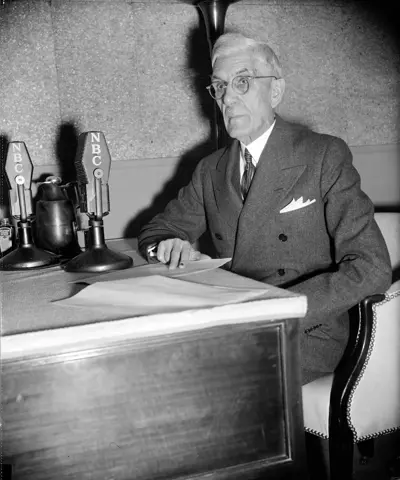
Francis Everett Townsend was an American physician who was best known for his revolving old-age pension proposal during the Great Depression. Known as the "Townsend Plan", this proposal influenced the establishment of the Roosevelt administration's Social Security system. He was born just outside Fairbury, Illinois, where he is memorialized by a post office named in his honor.
