Winston Churchill Quotes
In Franklin Roosevelt there died the greatest American friend we have ever known and the greatest champion of freedom who has ever brought help and comfort from the New World to the Old.
Winston Churchill, 1874-1965, British Prime Minister (Conservative), The Second World War
Sourced by: Eigen's Political and Historical Quotations


Hope cracked this joke after Franklin Delano Roosevelt was elected for an unprecedented fourth term as president:

FDR was terribly affable and was at the opposite end of the spectrum from the ideologues. Therefore he never offered specific programs. He was this grossly underestimated by many of the pundits of the day as being shallow with few or no ideas. Actually, he implemented more new ideas and programs than any other President in history but was very pragmatic about them and not really wedded to any of them. If one thing did not work, he tried another. The people and the Congress grew to trust him as no other president in our history although he always had his right wing enemies.


Coughlin was an early and valued supporter of FDR, but after Roosevelt’s election the priest became dissatisfied that Roosevelt was not radical enough. FDR also wanted to distance himself from many of the Fascist and Socialist ideas of Coughlin and especially his racism and anti-Semitism. Coughlin then flip-flopped and became a vicious Roosevelt Critic. Few realize that he ever supported Roosevelt.


Hoover, a brilliant administrator before his presidency, was so ideological about the role of government that when the Great Depression came, he was unwilling to use government directly to cope with the new problems. He was turned out of office in favor of FDR and the New Deal which the voters ratified 4 times. Hoover was embarrassed by the New Deal successes and lashed out with many insults. In this case, he called the New Deal “fascist”. See {629055} for another quote where he labels the New Deal communistic. Ironically, Hoover is rated by most historians as one of the least effective Presidents in American history while Roosevelt is always rated among the top 3 presidents.

In 1938 with America still in the depression, Random House published a 5 volume compendium of FDR's papers and speeches. It sold poorly.


There was a major leak of the administration’s contingency plans for war in Europe. FDR had run on a platform not to send American troops to Europe, and this leak, presented as a fete a compli, caused a political upheaval.
Roosevelt’s New Deal would have been impossible without the support of the Southern segregationists.
At that time, all the racist segregationists of the South were Democrats, unlike in the latter part of the 20th century where, after the Democratic President Lyndon Johnson, pushed through the Civil Rights Act, the segregationists accepted an invitation to switch to the Republican Party. In the 1930s, FDR’s Congressional majority depended on these segregationists. This is why, even though the New Deal liberalized most of American life, FDR did very little about racial equality and Civil Rights. In the 21st century, Republican Administrations could not do much about the remaining equality and civil rights issues. The racists of America, although far fewer in number, voted for the Republicans and were an important part of their base, just as they had been for FDR during the New Deal.


The Ambassador was not on the best terms with FDR. He met with the Luces, key Republicans on Wendell Willkie's team regarding his delivery of the Catholic vote.
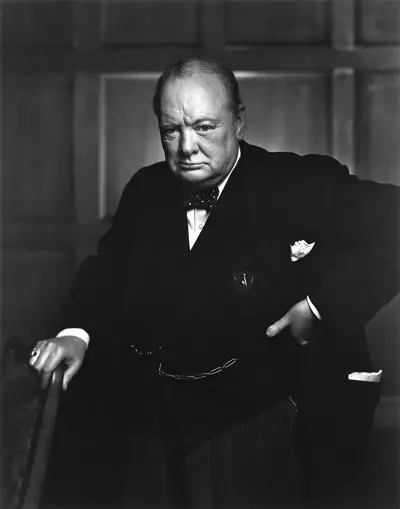
Sir Winston Leonard Spencer Churchill, KG, OM, CH, TD, DL, FRS, RA was the Prime Minister of the United Kingdom from 1940 to 1945, during the Second World War, and again from 1951 to 1955. Apart from two years between 1922 and 1924, Churchill was a Member of Parliament (MP) from 1900 to 1964 and represented a total of five constituencies. Ideologically an economic liberal and imperialist, he was for most of his career a member of the Conservative Party, as leader from 1940 to 1955. He was a member of the Liberal Party from 1904 to 1924. Churchill was also well known for his military career and as a historian, painter and writer, and among his many awards was the Nobel Prize in Literature.
