Winston Churchill Quotes

At the end of WWII there was much tension between Russia and the Anglo-American alliance. This plan was developed but never implemented. See {613195} for Prime Minister Winston Churchill’s description of the invasion idea.
At the end of WWII there was much tension between Russia and the Anglo-American alliance. This plan was developed but never implemented. See {613195} for Prime Minister Winston Churchill’s description of the invasion idea.


The Germans had invaded Russia who despite losing over 20 million people continued to fight the Germans who had never had to deploy forces over such a large territory. But it was the severe Russian Winter that turned the tide. Germans were not equipped or dressed for the terrible winter. The Russians were used to it. The Germans were repulsed and had to retreat back into Germany.


He was thrown out of the Labour Party for his pro Cold War and Soviet statements.

When McNamara was itemizing the list of dangers with the Joint Chiefs’ Cuban invasion plan, McGeorge Bundy told the not to forget the possibility of a nuclear exchange. The Joint Chief’s plan and recommendation was to invade Cuba, which could have been accomplished with relative military ease they thought. However, they had not gone the next steps and had no planned responses to the various possible Russian responses. The Chiefs of Staff were senior battle hardened WWII and Korean War veterans whose tactical knowledge and leadership was as good as there was. However, none of the had any experience or training with the strategic aspects of military planning the way senior military officers did in the next generation of military leaders. The civilian leadership had to put the breaks on the Joint Chief’s notion of simplistic invading Cuba.

This fact was one of the reasons that McCarthyism and HUAC were able to get traction. The Red Scare paranoids found something to really worry about. They overreacted, sensing the problem not as one of a large number of misguided and naïve people trying to help America do better, but as active spies controlled by the Kremlin who wanted to destroy the American way of life. There were two basic reasons these naïve officials acted that way. Many of them had not forgotten the devastation of the American people in the Great Depression and believed that capitalism had almost failed completely and the rough edge had to be taken off American capitalism by injecting some socialist principles such as stronger labor unions, ending racial and religious discrimination, controlling monopolies, and regulating critical industries. They also were mindful of the fact that the Russians were bearing the brunt of the WWII casualties—military and civilian—while killing more of the Germans and capturing more German occupied territory than the other allies together, yet they were not receiving the same level of assistance—technical, intelligence, economic and political as the British. They saw helping the Russians as saving American lives on the battlefield by making them more effective and keeping German soldiers and weapons away from the Western front and Americans. They also remembered that many in Congress were opposed to our entering WWII in Europe until Germany declared war on America. They had in many cases been apologists for Fascism and passionate enemies of communism. Some American industrialists like Henry Ford were anti-Semitic and overt admirers of Hitler. {586985} So these officials tried to redress the imbalance that existed while at the same time little was really known about Soviet Russia and the Stalin excesses that were as bad as some of Hitler’s. {634969} The only information Americans had were the terrible casualties the Russians were taking and the in kind that they were dishing out to the Germans. The number of Soviet spies in America were few and commensurate with the number of agents we had in Russia. But few Americans realized the difficulty the U. S. and the rest of the democratic world would have with Russia after the war was won.


United States F-15 war figure plans were engaged in war exercises within Estonian airspace with the approval and cooperation of the President and his government. However, Estonia has a common border with Russia, and when the American planes flew close to the border, Russian fighters rose and flew close to the American planes but staying on the Russian side of the border, warning the Americans by radio to respect Russian territorial sovereignty. Many people were concerned about the provocations and what that might lead to. President Llives however, was more worried about an accident leading to retaliation and a breakout of hostilities what no one intended.

Several weeks later the U. S. blockaded Cuba in what became known as the Cuban missile crisis, to remove the Soviet offensive nuclear capability from Cuba.
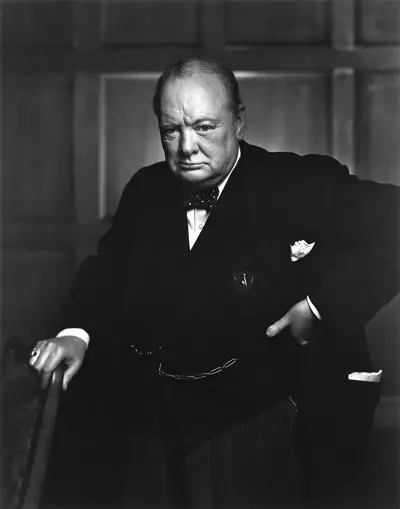
- Born: November 30, 1874
- Died: January 24, 1965
- Nationality: English
- Profession: Statesman
Sir Winston Leonard Spencer Churchill, KG, OM, CH, TD, DL, FRS, RA was the Prime Minister of the United Kingdom from 1940 to 1945, during the Second World War, and again from 1951 to 1955. Apart from two years between 1922 and 1924, Churchill was a Member of Parliament (MP) from 1900 to 1964 and represented a total of five constituencies. Ideologically an economic liberal and imperialist, he was for most of his career a member of the Conservative Party, as leader from 1940 to 1955. He was a member of the Liberal Party from 1904 to 1924. Churchill was also well known for his military career and as a historian, painter and writer, and among his many awards was the Nobel Prize in Literature.
