Anatole France Quotes
You think you are dying for your country; you die for the industrialists.
Jacques Anatole Francois Thibault
Anatole France 1844-1924, Nobel Laureate in Literature [France], L'Humanité, July 18, 1922)
Sourced by: Eigen's Political and Historical Quotations


The “old” writing to which he was referring was a quotation from Roman Poet Horace. See {589060}.


This was one of the statements that he was jailed for during WWI.

Quintus Horatius Flaccus. This famous quotation has been echoed in virtually every language and every country of the world. However, see Ernest Hemingway for a counter view.


Even as he was being executed for his many war crimes, the Field Marshal exhibited the mental perspective of Germanic patriotism that had brought Europe as well as Germany itself so much death and ruin.


Drumbo was morally opposed to war. He also refused to name Hollywood communists to Congressional Committees during the Red Scare. He was then blacklisted from his occupation, screen writing.


Leaders of nations for years only trusted as truly patriotic those man—usually nobles of the aristocracy—who owned land. If an invader came and seized their land, they would lose their wealth. However money is fungible, and a banker can easily move his money abroad and join another nation or side in a war. If the country is ruined by war, the manufacturer cannot obtain labor or raw materials, The financier depends on none of these and so hs not the vested interest in the welfare of the nation.


At the time, the Russians and the Nazis had a pact and were allies so the Russians did not want the U.S. in the war. When the Russians changed sides, the Communist party line reversed itself and military of other aid to Russia was advocated as well as direct entry into the war. See {598503} for additional communist slogans of the day.


The last phrase was a variation of the famous Bismarck quotation {594849}.

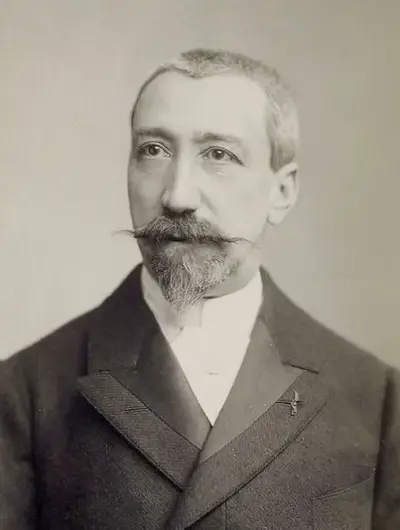
Anatole France was a French poet, journalist, and novelist with several best-sellers. Ironic and skeptical, he was considered in his day the ideal French man of letters. He was a member of the Académie française, and won the 1921 Nobel Prize in Literature "in recognition of his brilliant literary achievements, characterized as they are by a nobility of style, a profound human sympathy, grace, and a true Gallic temperament".
