Ronald Charles Lindsay Quotes
You Americans can threaten, but you can never promise and you can never fulfill a promise.
This is a complaint that many nations make against the United States. Few foreigners really understand the United States form of government which differs from the usual Parliamentary form that exists in most of the world. Specifically, in the Parliamentary system, the Government (Executive Branch) and the Legislature are one and the same. Often it includes the judiciary. In America we have separation of powers and these branches not only are not coordinated and consistent but are often at odds with each other. As a result, Presidents and Secretaries of State can make honest commitments and promises but later find that the Congress will block American fulfillment of the promise. At the time, the most glaring example was President Wilson who was so active in advocating a League of Nations and then when it became a reality, the Senate would not ratify the treaty and America could not join, thereby dooming it to failure. There have been many other examples in history. Another dramatic one was President Obama promising to close the prison camp at Guantanamo Bay during the War on Terror, Congress would not appropriate any funds to move the prisoners anywhere else, and the President’s promise to other nations could not be fulfilled. This is a structural part of the American system. Some people see it as a weakness; others, as a strength.
Ronald Charles Lindsay, 1877-1945, English Ambassador to the United States, Comment to American Secretary of State Henry L. Stimson
Sourced by: Eigen's Political and Historical Quotations

See {641688} for a similar criticism of the Obama Syria policy.


Truman had to deal with Stalin for many years. In earlier days he had a much more favorable view of the Russians. See {626410} for his view 22 years earlier.


There was some fear in the North that the shots fired by the Southern rebels, might encourage one or more of the European Powers to start a war with the United States. And if the Rebellion turned into a full scale Civil War, the South would surely encourage such acts be promising trade concessions in the export of Southern cotton. Seward’s confident and bellicose statement distressed some Union colleagues who feared that Seward might anger and provoke one of more of the machismo and nationalistic European Powers. However, if Seward was bluffing, the bluff worked. No country encroached on American interests during the Civil War. If he was not bluffing, he certainly, along with many others, understated the difficulty that the North would have putting down the Southern rebellion.

They were both children of Queen Victoria of England.

Germany was the enemy but the allies were fighting with each other over the treaty negotiations. David Lloyd George was the Prime Minister of England who was negotiating for that country.

Diplomatic recognition of the People’s Republic of China was being debated. Many of Churchill’s Conservative Party Colleagues were opposed on the grounds that diplomatic relations gives a signal of legitimacy. In the U. S. this general issue is a constant source of political controversy when diplomatic relations and talks are considered with Iran, Cuba and North Korea.

With promises the success lies in following through and keeping the promise which is usually very costly. A threat that fails meanwhile can be the most expensive thing. We make a threat to deter a foreign power from something. Failure occurs when they are not intimidated and go ahead anyway. Then if we follow through on the threat, that is very costly—a war, a trade embargo, or whatever. Not following through on the threat is the costliest of all as we lose our credibility, trust and honor.

This quotation is very interesting in that it shows a President who was not very happy with the policies of his own Secretary of State. This would never have happened overtly after the FDR presidency. Prior, the Secretary of State had a great deal of independence of operation, which was one of the reasons that it was such a prestigious position. However, on modern times President’s would never publicly criticize their own Secretary of State. They would either control the policies directly, accept his/her actions as their own, fire the Secretary, for force him/her to resign as George W, Bush did with Colin Powell. Also, most Secretaries of State, spending most of their time on foreign affairs, become much more sensitive and sophisticated to the intricacies of the world situation, that their nuanced views are very often not viewed by American public opinion as sufficiently pro American. At the same time, there has been a tradition in America that the Secretary of State does not engage in domestic politics, so does not always seem to be pro American.

At the time Japan had a strong Fascist military wing and the army was not under the control of the civilian government. The government diplomats were less aggressive and expansionist as the military was. The Japanese diplomats would assure other governments like the United States of their peaceful intentions and then the Japanese army would do something that was completely contradictory. As the militarist wing gained domination over the government, the diplomats would strategically lie, and then claim what whatever the army did, was done be rogue officers and was not part of government policy. See {627085}.
At the time Japan had a strong Fascist military wing and the army was not under the control of the civilian government. The government diplomats were less aggressive and expansionist as the military was. The Japanese diplomats would assure other governments like the United States of their peaceful intentions and then the Japanese army would do something that was completely contradictory. As the militarist wing gained domination over the government, the diplomats would strategically lie, and then claim what whatever the army did, was done be rogue officers and was not part of government policy.

The Dutch Monarch William V, Prince of Orange, was in a very precarious position and might be deposed. Officially Harris and the British were supporting him and Harris was giving him money to firm up his regime, but their great fear was that the French would support and control the Patriot Revolutionary movement, then quite active or even intervene militarily to aid the Patriots.


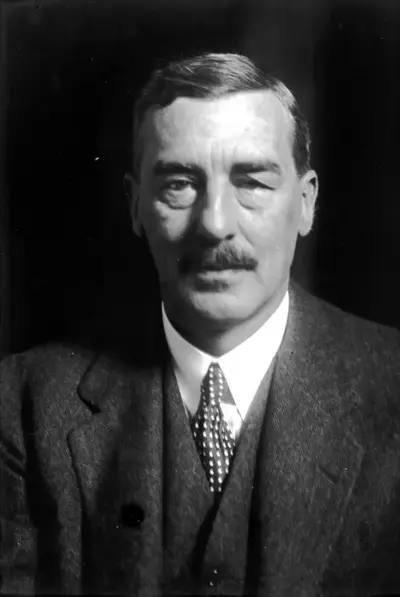
Sir Ronald Charles Lindsay GCB KCMG CVO PC was a British civil servant and diplomat. He was Ambassador to Turkey from 1925 to 1926 and to Germany from 1926 to 1928, Permanent Under-Secretary for Foreign Affairs from 1928 to 1930 and Ambassador to the United States from 1930 to 1939.
