Robert Woolley Quotes
Yes or No, Mr Hughes?
Whether or not the United States should enter WWI was a major issue of the day. One wing of the Republican Party had been attacking Wilson for his “weakness” of not warring against Germany in spite of the provocations and attacks on ships killing Americans. However the majority of the voters were opposed to U. S. involvement in the war. If Hughes was for war, he would lose many votes; if he was against the war, he would lose the support of one half of his Republican base. His dodging the issue however lowered much of his public esteem. Woolley made sure that before and after every Hughes speech, reporters would ask him for his stance on the war, and the advertisement with this question.
Robert Woolley, * Newspaper Publisher, Journalist, Director, Democratic National Committee's Publicity Bureau,, Director of the U. S. Mint (Democrat), Presidential Campaign Tactician, Advisor, and Activist, Innovator of Modern Campaign Tactics, Newspaper advertisement that Woolley placed in the local newspapers the day before Wilson’s Republican opponent Charles Evans Hughes was to make a campaign speech, Presidential Campaign, 1916
Sourced by: Eigen's Political and Historical Quotations

Hughes constantly allowed that it was improper for a sitting Supreme Court justice to be a candidate for the Presidency. But the Republican Party was badly split between the progressives and the conservatives. Each likely candidate had been on one side or the other, and was therefore unacceptable to the wing he had not supported. Hughes was one of the few Republicans who did not take sides in the 1912 schism as he was a member of the Supreme Court. His neutrality and his absence of any political statements in recent years made him a very attractive Presidential Nominee for Republicans. But his luster would wear off quickly if he let the Republicans know how he stood on any of the issues splitting the party. The only way that he could avoid saying anything was to maintain that he was not and should not be a candidate. Therefore he was nominated. However, to avoid losing one of the wings of his party, he had to essentially take a position on very few issues in the 1916 campaign. He just criticized President Woodrow Wilson and the Democrats. See {642634} for how the Wilson forces turned his avoidance of issues to their advantage.


During the 2012 Presidential Campaign, he was explaining to the press why he was not responding to accusations that he had lied about no longer being associated with the Bain Capital Corporation when he was running the Winter Olympics. Unfortunately for Romney, 6 days later he went on all the networks to respond to the charges and then most people were exposed to the fact of the responses and this earlier quotation. Romney tended to change his mind on many issues like the tactics of how and when to respond, and for many voters this made him seem like a flip flopper without much integrity and consistency.


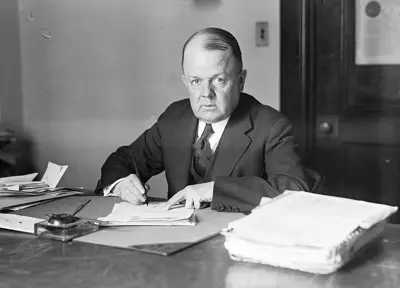
- Born: April 29, 1871
- Died: December 15, 1958
- Nationality:
- Profession:
Robert Wickliffe Woolley was an American Democratic politician from Washington D.C.. He was Director of the United States Mint from 1915 to 1916, and a member of the Interstate Commerce Commission in 1920. He was a critic of American fuel consumption.
