James B. Clark Quotes
William Judas Bryan.
In the Democratic national convention of 1912, Clark had obtained a majority of the delegate votes and was well on his way to the two thirds necessary for the Presidential nomination. William Jennings Bryan, a close personal friend of Clark's, headed the Nebraska delegation which had already instructed Bryan to vote for Clark. However, in a dramatic repudiation of his old friend, Bryan switched to Woodrow Wilson and turned the tide against Clark, who characterized Bryan as:
James B. (Champ) Clark, 1850-1921, U. S. Congressman (Democrat, MO), Speaker of the House, Remark, Democratic National Convention, 1912
Sourced by: Eigen's Political and Historical Quotations


Clay came from the western part of Kentucky—then the "western" part of the United States.


The Fascist Dictator hinted at all the Church property that the State might seize and began to place taxes on the Church and in a brilliant political stroke actually negotiated the Lateran Pacts of 1929 with the Church whereby the Dictator would guarantee all the churches property and protect its officials end exempt the church from taxation and all the Church had to do was have all their Italian Bishops swear to this oath of political support for the dictatorial fascist state and its outrages and aggression and denial of rights. He actually have the church more religious power than they had enjoyed in Italy for years. For example he turned over the public school curriculum to the church with no other religion considered. Despite thus oath of the Italian bishops, there were a number of individual Catholic priests who aided the anti-Fascist resistance, but for the most part Mussolini bought the political and moral support of the Catholic Church. Apologists for the Church at the time point out that the entire Vatican and the Pope was totally within the dictator’s span of control, and he could jail any of the Holy see who criticized him or have them executed as he did so many others. He could also loot the Vatican and sell off holy relics and other object to finance his wars of aggression and his alliance with Hitler. They argue that there was nothing any priests could say that would break the iron hold Mussolini had on Italy and at least, the priests could perform their pastoral functions so long as they supported the Fascists. The debate continues to this day. However, after WWII Italians left the Catholic Church in droves and it is one of the least religious states in Europe.


This quotation illustrates one end of the range of union leadership regarding communism. Some union leader were communists; some were pro Marxist but against the Russian style of dictatorial communism. Others did not care for Communism at all but saw the communists as an effective tool that really frightened American corporate management and politicians so they looked reasonable by comparison and they therefore wanted the communists around. Last were those like Reuther who was aggressively anti-communist and wanted labor to expel them whenever they turn up. However, what is ironic is that Reuther himself was labeled a Communist by many right wingers who also used Reuther’s “duck” test. Reuther wanted a national health insurance system; so did the Communists. He advocated and end to segregation; so did the Communists. He fought for workers having a say in management, a classic communist demand, and many other similarities.

Actually, both political parties had a range of opinion on the issue of control of the trusts, monopolies and large corporations. Roosevelt and his liberal wing of the Republic opinion were for regulating corporations and strengthening and enforcing the anti-trust laws. However, many of his party refused to admit that there were any abuses and/or if there were, the effect of Federal regulation and anti-trust enforcement would be worse that then problems caused by the trusts. At the same time, the Democrats had Bryan’s wing that wanted to break up the trusts and large corporations, and that is why Roosevelt had so much public support—enough to pass the legislation and make the President’s initiatives very popular. Roosevelt a shrewd campaigner attacked the Democrats knowing full well that many agreed with him, and ignored the conservative wing of his own party who were the ones who actively opposed his corporate reform effort.

Samuel Langhorne Clemens, 1835-1910

Hitler was partially right. Many of the best and accomplished minds in Germany, Jewish and not, left the country when he came into power. However most stayed and when Hitler was successful they went along with the Nazi winners and “put their minds at the disposal” of the Third Reich.


This point of view is not held by the majority of politics thinker but it is the view of more than a few. Others argue that it is a response to decades of undemocratic conservative policies. Still others argue that it is a response to decades of undemocratic unfair and unequal results of policies—liberal or conservative. In America, the inequality gap that produced the publish at the time of his quotation had ben the result of 40 years of Democratic and Republican control; and policies, liberal and conservative,


He was reacting to President Donald Trump's demands of Personal Loyalty of his appointees. Trump was a businessman who ran provate (not public) corporations where it was not unusual for the owner to demand personal loyalty of all his key employees. He had not historical knowledge of experience with public service in America where, unlike campaigns, all officials take an oath of loalty to the Constitution and the nation and not to the President. Trump had fired the then FBI Director who was investigationg his campaign for illegal contacts with the Russians, which Trump regarded as an act of disloyalty, especially when the Director refused to pledge his loyalty to Trump.


In contrast to Trump, most political leaders engender loyality via their exemplary and admirable personal qualities and character and/or via a shared philosophy or ideology. Their loyalty tends to transcend proagmatics and the utility of the moment.


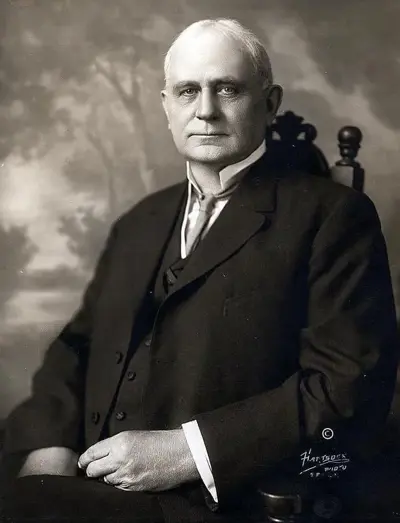
James Beauchamp Clark was an American politician and attorney who represented Missouri in the United States House of Representatives and served as Speaker of the House from 1911 to 1919.
