Mark Twain Quotes
Who are the oppressors? The few: the King, the capitalist, and a handful of other overseers and superintendents. Who are the oppressed? The many: the nations of the earth; the valuable personages; the workers; they that make the bread that the soft-handed and idle eat.
Twain, Mark. A Connecticut Yankee in King Arthur's Court. Charles L. Webster & Co., 1889.


He was a strong opponent of communism (see {586209} and {586210}) but was also skeptical of unbridled capitalism.


Salisbury was a brilliant, effective prime minister, but he was a snob and not a democrat. See {639131}.


He was a strong foe of both Communism and Capitalism. He was one of the first critics to describe the de facto inequality of Communism.

There were many British and American capitalists, like Lindbergh, who were great admirers of Hitler and Mussolini and supported the Fascists.


This quotation is interesting for two reasons. First it is a good example of the twisted logic of some of the Slavery apologists who claimed that the Negro slave was better off than the free wage earner. The second reason is that it illustrates the norms of the treatment of the working man before the Civil War. The union movement would change the situation for the free laborer over the next century and then holidays and worker rights became normalized in American society. See {641290} for another of his absurd arguments.
This is one of the major reasons that Slavery was so hard to end in the South. At the time, the dollar value of the Southern slaves was greater than the value of all the land, factories, inventory, and capital equipment of the South. Slaves were not only capital, they were the largest component of Southern capital and Southern wealth. There were numerous ideas of paying slave owners for the freedom of their slaves, and if this was done, it would have been far less expensive in money alone than the Civil War cost. However, the Southern leadership, like Fitzhugh, were totally intransient with culture and customs—indeed the Southern concept of manhood—was dependent in Slavery. The result was that no compensation was paid to slave owners and the South was impoverished as a result of its capital loss and it would not recover for 150 years.


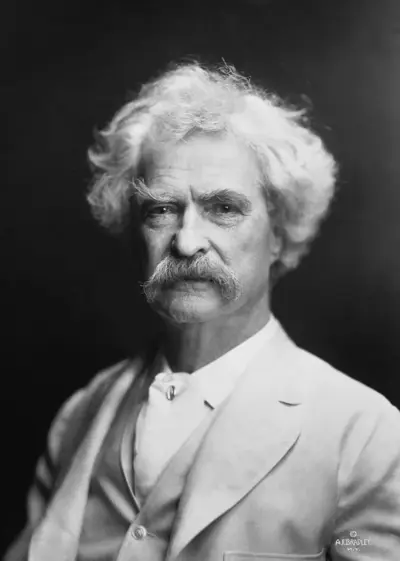
Samuel Langhorne Clemens, known by his pen name Mark Twain, was an American writer, humorist, entrepreneur, publisher, and lecturer. He was lauded as the "greatest humorist the United States has produced," and William Faulkner called him "the father of American literature". His novels include The Adventures of Tom Sawyer (1876) and its sequel, the Adventures of Huckleberry Finn (1884), the latter often called "The Great American Novel".
