Joseph Smith Jr. Quotes
Were I president of the United States, by the voice of a virtuous people, I would honor the old paths of the venerated fathers of freedom; I would walk in the tracks of the illustrious patriots who carried the ark of the government upon their shoulders with an eye single to the glory of the people and when that people petitioned to abolish slavery in the slave states, I would use all honorable means to have their prayers granted, and give liberty to the captive.
Joseph Smith, Jr., 1805-1844, Founder of the Mormon Religion, General Smith's Views on the Powers and Policy of the Government of the United States, Platform for his run for the Presidency, February 7, 1844
Sourced by: Eigen's Political and Historical Quotations

One of the many complaints that many people made at the time about Smith and his Mormons was that they opposed slavery. In fact, Smith not only opposed it be had a plan for compensating the slave owner and a method for paying for it. Smith was not advocating the kinds of personal lifestyle issues of his church the way modern religious leaders do, but was concerned with the much larger issues of expansionism, corruption of the courts and judiciary, and land distribution. He was a classic reform candidate in that sense. Smith had written to most of the then likely Presidential candidates of both major parties asking for their position on the Mormons who were facing persecution wherever they went. None of the politicians would make any satisfactory commitments. Smith took Direct Action and became the only major religious official to have run for the Presidency of the United States until Pat Robertson tried and failed in 2000. Smith’s assassination shortly thereafter cut his run for the Presidency short before it made much headway and politically he had no chance to affect the race.

Young and the Mormons sent missionaries to many counties and made many converts. Since few countries provided a great deal of religious freedom, Young and other Mormons believed that God himself had created America with its freedom. Ironically, it was this advertising of America as a land of freedom that caused many Americans to discriminate against Mormons. The issue of Mormonism was conflated with a strong nativist and anti-immigrant sentiment that has existed among a part of the American population throughout its history. Many opposed the Mormons for the main reason that they were encouraging and in many cases aiding large numbers of immigrants to the United States.


Earlier {629154} Smith was much more sympathetic with slavery. His views evolved as you can see by the comparison. He stated that he had a vision and made two prophesies {629156} that indeed came true. The last idea of slave buyouts seemed plausible to many abolitionists initially when they were not really knowledgeable about the economics of slavery. However, once they studied it, it became clear what it would not work even if the Southerners would then be willing to accept Blacks as free laborers which most were not, The two biggest problems were: 1) the international slave trade had been abolished. The only source of new slaves for growth was breeding them. Therefore, having slaves had TWO economic values—the work that they could do and the reproduction of themselves. A critical mass of owned slaves produced an income forever. And for Southerners who were culturally adverse to work (see {629169}), just having cash for their slaves was not enough. They were the servants, the farm labor, and their recreational sex. 2) and most important, the value or the slaves of the South was greater than the economic value of all the land, all the farms, all the buildings, all the factories, and all the inventory of the stores of the South all put together. The Southern slaves were the majority of the wealth of the south. There was no asset that could ever produce enough value to pay for the slaves—even over time. It would be like trying to buy all the shares of all the corporations in America today. There is no asset big enough to raise the money to ever finance it. The idea may have worked in Colonial America or even prior to the outlaw of the international slave trade, but by the time anyone took the idea seriously it was economically no longer feasible.

Even before we had a Constitution there was major opposition to slavery. The “price” of the American Union was the acceptance of the slavery of the South. But the hypocrisy of a country based on liberty to allow and enforce slavery was not lost on the founding fathers. Ironically the abolitionists among the founding fathers were certain that they could persuade the Southern slaveholders of the error of slavery in a few years and things would be set right in the land. Even George Washington {630626}, and Thomas Jefferson and some other slaveowners at the time wished to see its abolition. Slaveholding Southern Founding Fathers in general were so wary of the abolitionists that they achieved structural, disproportionate, power in the new Constitution to ward off the abolitionists attempts to reform slavery.

Though Leo XIII was very much opposed to slavery, his claim that the Catholic Church “from the beginning” sought to end slavery overlooks the inconsistent reality of several of his predecessors’ teachings. For an example of this inconsistency one may find a relevant example as late as the 19th century, see the teachings of Gregory XVI {611428}, Pius IX {612304}, and Leo XIII {611844}


Tilden won the popular vote but was one vote short of the number he needed in the electoral college so the election was thrown into the House of Representatives. The Southern Democrats made a craven deal with the Republicans, whereby they would abandon Tilden and Vote for Rutherford Hayes, and Hays and the Republican Majority in Congress would remove all Federal Troops from Southern States. The Federal Troops were the only force that protected Black rights won after the Civil War, and the South wanted to disenfranchise the Blacks. Hays became president and kept his part of the immoral bargain. With the exception of this act that put the nail in the coffin of civil rights in America and sold out the Blacks for another 80 years. (Without Federal Troops, the KKK was the dominant force in the South.) Rutherford was a good President. But race was at the heart of this disputed and unfortunate election.

The first anti-slavery newspaper published in the United States & the first journal in America to advocate immediate, unconditional emancipation

He was very critical of many of the politicians of the day who were self serving and corrupt.


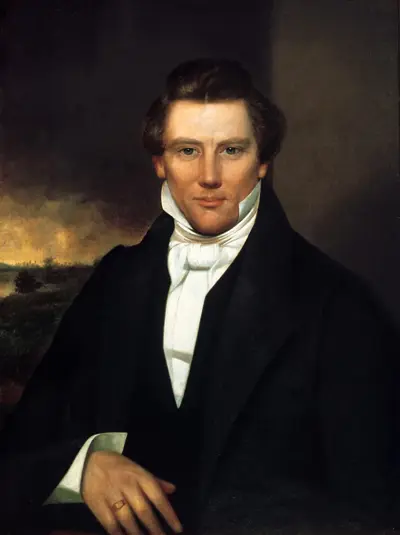
Joseph Smith, Jr. was an American religious leader and founder of Mormonism and the Latter Day Saint movement. When he was twenty-four, Smith published the Book of Mormon. By the time of his death fourteen years later, he had attracted tens of thousands of followers and founded a religious culture that continues to the present.
