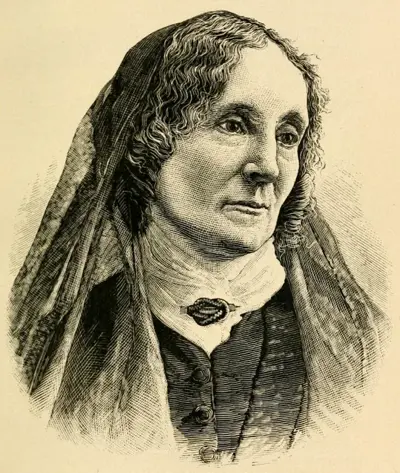
Eliza Jane Thompson Quotes
Well men have been engaged in this tomfoolery long enough and the Good Lord has seen fit to start having women engage in it also.
Eliza Jane Thompson, 1816-1905, Leader of America’s First Prohibition Movement, Response to her husband, a judge, who called public demonstrations and politicking by women “tomfoolery.”
Sourced by: Eigen's Political and Historical Quotations


Many politicians in that day would campaign from large carts drawn by oxen – a predecessor to the bandwagon of sorts. She was 1 of the 4 women who entered Oberlin College in 1837 thus becoming the first co-educational institution of higher education in the United States.


Marcus Porcius Cato. This quotation has had two different interpretations over time. One was that women if they received equality of treatment and voting would have an advantage for they also had their traditional “feminine wiles” and their sexuality, hence would dominate men. The second was a also a warning but based on the fact that women were superior in many ways, and given an equal chance, would excel men. The later interpretation is argued by some who point to the 2011 American data that shows more females than males graduating from high school and college, and females outnumber males in medical, law and several other professional schools. With the exception of a few Roman men, most heeded Cato’s warning and never took a chance on female equality.


Jinnah was a modern Islamist who saw the role of females in a modern context. He, like the Indian Hindu leaders were in a sense products of the West and Western government and education. He would be very surprised that in his Pakistan men can murder their female relatives who they believe have dishonored the family, or that women would not be educated in the Madrassas, or that authorities could sentence a female relative of a man deemed guilty of seduction to be gang raped, but that is what happens in modern Pakistan. Jinnah and many of the early leaders believed that their new government could modernize Islam but the control and influence went the other way. Pakistan became a religiously dominated autocracy rather than the democracy that Jinnah foresaw.


She was the First Lady, who in many ways was also one of the nation’s leading feminists. Betty Ford, Barbara Bush, and Hillary Clinton were also First Ladies who supported key feminist position but ER was 30 years ahead of them—a time when conservatives and sexists viewed her as a dangerous radical. For example, see {585211}.
Mrs. Roosevelt thought that with the rate of improvement in society’s perception and treatment of women was improving so steadily that women in America were not far from equality. Because of the shortage of men on the home front in WWII women had performed well in virtually all occupations including welding, heavy construction and management and it was just a matter of time to reach equality of pay and parity. However, she and most feminists did not take into account the 2 million men returning from military service who wanted their jobs back. Sexists, who had been suppressed during the war when they objected to women in non traditional occupations, were no longer silenced by national necessity. An occupational backlash developed. Then a sexual one regarding contraception and family planning, (Condoms for example were illegal up to 1963 as birth control device). Each major step forward was accompanied by its own backlash and even in the Presidential Campaign of 2012 contained debate on women’s control over their own bodies relative to abortion and contraception.