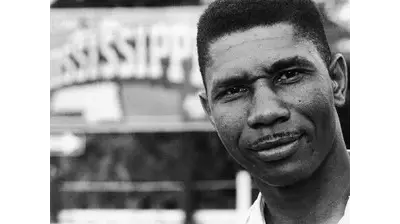
Medgar Evers Quotes
We left the guns hidden in the car and tried walking into the polling place again, and the mob blocked us again. We didn't pursue it.
Evers, Medgar. "Why I Live in Mississippi." Ebony, vol. 14, no. 1, Johnson Publishing Company, Nov. 1958, p. 66.

The marshal was embarrassed by his assignment to arrest this famous, elderly woman. He refused to handcuff her, gave her time to change her clothes, and took Anthony by streetcar to the courthouse trying to keep as low a profile as possible while Anthony was making speeches all the way about her unjust arrest. She was found guilty and fined $100 which she never paid.

The all white regular Mississippi Delegation was selected in elections where Blacks were barred from voting although Blacks were in the majority in Mississippi. In addition, the regular party was advocating obstructing the Supreme Court school integration decisions and the Civil Rights Act that had just been passed. See {637616}. The insurgent group was selected in integrated elections, contained black and white delegates, and was pledged to support and obey the laws. The President could not make the decision unilaterally, but had a great deal of influence.

At the time Negroes were prohibited from voting by a series of discriminatory criteria for voter registration and intimidation so that Blacks would not generally even try to register. But the Civil Rights movement changed tactics and organized large scale attempts at voter registration. Mayor Thompson and the white power structure of the town were not going to allow that. They had not only enlarged the police department but the city purchased an a small armed tank.


Opposing national attempts to give Blacks the vote in the South:

Bruce was the first Black to complete a full term in the Senate

Even in modern times Alabama election manipulation is in great part driven by the views of an ever diminishing racist white proportion of the voters.


The Republican party in the beginning of the 21st century had veered sharply to the right. Since the party controlled a many of Governor’s and state legislatures, some overly partisan people started passing laws and election rules that would inhibit the poor and minorities—who tended to vote Democratic—from voting. This was opposed by many of the traditional Republicans who had been national leaders over the years in expanding and facilitating voting.

At that time a number of state legislatures all changed their state voting laws to require citizens who try to register to vote to have documentation of various kinds and or obtain special documentation. These were generally possessed by upper class and educated people but not in as large proportions by lower and working class people. To obtain the documents and register if things like original birth certificates were not possessed, the citizen had to lose much of a day’s work and travel some distance. The burden existed on most lower class people and especially the minorities. The courts nullified some of these discriminatory requirements for voter registration, but many were allowed. The rationale was to prevent voter fraud and yet there were almost no cases of voter fraud in the entire country. While the requirements were racially discriminatory, they were also socioeconomically discriminatory. By coincidence, or perhaps not, every state that added these requirements had a Republican controlled state legislature AND a Republican Governor. Despite the effort to suppress Obama and Democratic voters, the effort backfired. Minorities and especially Blacks were so outraged that Jim Crow voting suppression had returned that they made a huge effort to register and get out the vote and Blacks voted in a much larger proportion than historical and well over 90 percent voted for Obama who won the election handily.

Preclearance was a requirement that any change in the voting or registration laws, rules or procedures needed to be approved by the Federal Justice Department.
He was explaining why preclearance was necessary. Preclearance was a requirement that any change in the voting or registration laws, rules or procedures needed to be approved by the Federal Justice Department.

Preclearance was a requirement that any change in the voting or registration laws, rules or procedures needed to be approved by the Federal Justice Department. He was testifying about why preclearance was important and why it was placed in the Voting Rights Act every time it was reauthorized. See {635271} for what happens without preclearance.


City of Oxford
