Marquis de Lafayette Quotes
We have made an admirable and almost incredible destruction of all abuses and prejudices; that every thing not directly useful to, or coming from, the people has been leveled.
Marie Joseph Paul Yves Roch Gilbert du Motier
Marquis de Lafayette, 1757-1834, French Statesman & Major General in the American Revolutionary Continental Army, Member of the French Chamber of Deputies, Letter to George Washington, March 17, 1790
Sourced by: Eigen's Political and Historical Quotations

1st Duke of Wellington


Tamoyo ceased publication in 1823. It’s name comes from the name of an indigenous Indian tribe. A region of Brazil has been given the same name.


In the late 1830's a revolutionary political movement of small tenant farmers grew in upper New York State. There was much violence and anti-renters were hanged and jailed. After a few years they elected 14 members of the state legislature and had their fellows pardoned:


At the time, Capetown was under the control of the Dutch East India Company which had recruited Gordon from Scotland. There was a wave of liberality following the Enlightenment, the American Revolution, and the very vocal English, anti-slavery, reformers. The Dutch were concerned mainly with making money, and that they thought that meant stability and the status quo. Gordon was their strong spokesman on this. Like American Southern slave owners, Gordon read the Bible as God endorsing slavery and the inferiority of Blacks. Thus, reformers did not "believe in God any more".
The Diggers were a religious-economic movement that even today would be considered very radical. They advocated the right of the poor to go onto public lands and farm them—thus the name “Diggers.” Beyond their opposition to the private ownership of land to the exclusion of the poor, Winstanley and the Diggers promulgated another very modern doctrine: That the poor should take the responsibility and have the right to determine how the society should provide for the poor. A version of this became one of the Mottos of the Poverty Program of 1964. See {616966}.

Harding, not the most historically knowledgeable of American Presidents, had forgotten the revolutionary origin of the United States or its drastically experimental nature. It was the fear of Communism and the Russian Revolution that gave revolution a bad name at the time.

Garfield reminded Americans of how radical and unusual the concept of democracy had been at the time of the adoption of The Constitution, and that the American Revolution was one of ideas as well as armies.
There were many Americans who were Tories and proBritish. There were also many who, while they were not pro British, were not enthusiastic about the Revolution and the death and devastation that it brought. In France however, the American Revolution was seen in much more romantic and theoretical terms. See {621958} and {621957}.


the Dutch monarchy supported by England The French fear of course was that the revolutionary fervor spreading to the bourgeois could easily spread to France, and that is exactly what happened 4 years later. See {639769} for more of his view on the Dutch revolutionary spirit that might infect France.
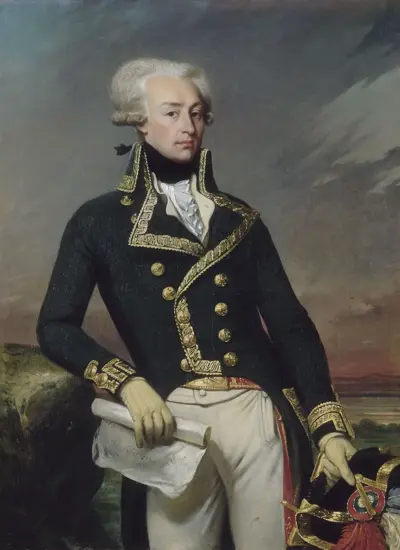
Marie-Joseph Paul Yves Roch Gilbert du Motier, Marquis de La Fayette, known in the United States as Lafayette (/ˌlɑːfiːˈɛt, ˌlæf-/, French: [lafajɛt]), was a French aristocrat and military officer who fought in the American Revolutionary War, commanding American troops in several battles, including the siege of Yorktown. After returning to France, he was a key figure in the French Revolution of 1789 and the July Revolution of 1830. He has been considered a national hero in both countries.
