Council of Pisa Quotes
We, each and all, bishops, priests, and deacons of the holy Roman church, congregated in the city of Pisa for the purpose of ending the schism and of restoring the unity of the church, on our word of honor promise God, the holy Roman church, and this holy council now collected here for the aforesaid purpose, that, if any one of us is elected pope, he shall continue the present council and not dissolve it, nor, so far as is in his power, permit it to be dissolved until, through it and with its advice, a proper, reasonable, and sufficient reformation of the universal church in its head and in its members shall have been accomplished.
At the time there was no pope. Before an election for one was held, all the electors made the collective oath and promise to maintain the idea of a council of clerics if he were elected Pope. After the Pope was elected, the bishops solidified their power even claiming ascendancy and authority, when assembled, over the Pope. See the Council of Constance {610980} 6 years later.
Council of Pisa, On the Powers of the Council, 1409
Sourced by: Eigen's Political and Historical Quotations

The struggle in the Catholic Church reached an amazing state. Just after a new pope, Martin V, had been elected the Council of Bishops at Constance came up with this notion which placed their views above those of the Pope under the theory that this particular council derived its power and authority directly from Christ while the pope was only God’s “vicar on earth.” The struggle was somewhat akin to the inevitable struggle for power between an executive branch and a legislative branch. The Council’s ascendancy didn’t last very long and was repudiated by successive popes.


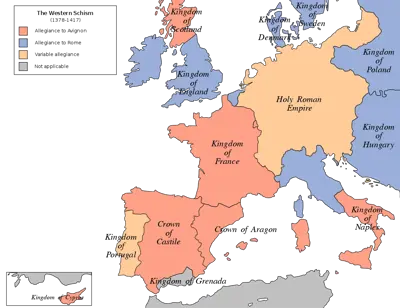
There was a schism in the Catholic Church. Based on the “flawed” election described by the protesting Cardinals herein, the Revolting Cardinals had their own election, selecting Robert of Geneva--Clement VII, and moved their papacy to Avignon, France where they built a fortress that the mob could not storm. For years there were two Popes and two sets of Cardinals fighting it out.

Papal letter to Cardinal James Gibbons. For an example of Gibbon’s strong loyalty to America, see {611353}.


There are some who question the authenticity of this Bull. However, its existence was supported by John of Salisbury who claimed to be the emissary who arranged the Bull. See {611696}. However, those who are shocked that the Pope could have been so crass as to “give” a country to Henry II for money have claimed that the writing of John was also a forgery,


The church attempted to retain its role as the premier Russian religion, and maintain its traditional influence and autonomy. It was not to be.
The Church exercised the law enforcement and censorship authority in all Catholic countries. Note the offense of saying anything which is “offensive to pious ears”. The particular example that “offended” the pious was that a heretic should not be executed. These were the cultural values of the day.

The council was not only fearful of Protestant preaching, but hereby granted a local monopoly within the Catholic Church to the local Bishop.


The Christian Roman Empire was split in two—a Western (Latin) Empire led by the Roman Catholic Church in Rome, and the Eastern (Greek) Roman Empire led by the Orthodox Church headquartered in Constantinople (Byzantium). The two churches were not only in a theological conflict but violence broke out and the armies of the two religious empires attacked each other now and then. In 1439, leaders of the two versions of Christianity met in Florence, and they agreed to reunuion in which the Eastern Orthodox would again acknowledge the authority of the Pope. This was not a popular agreement with the majority of the Eastern Orthodox people and some of the clerical leadership. Constantine, realizing that he did not have pubic support at home for the end to the schism and the acceptance of the authority of the Pope, kept stalling on officially announcing and implementing the unity treaty. The Pope’s patience was wearing thin. Constantine did not adhere to ther treaty and the two churches have been apart ever since.

- Born:
- Nationality:
- Profession:
The Council of Pisa was a controversial ecumenical council of the Catholic Church held in 1409. It attempted to end the Western Schism by deposing Benedict XIII (Avignon) and Gregory XII (Rome) for schism and manifest heresy. The College of Cardinals, composed of members of both the Avignon Obedience and the Roman Obedience, who were recognized by each other and by the Council, then elected a third papal claimant, Alexander V, who lived only a few months. He was succeeded by John XXIII.
