Council of Trent Quotes
Cardinals and all Prelates of the churches shall be content with modest furniture and a frugal table: they shall not enrich their relatives or domestics out of the property of the Church
Council of Trent, Roman Catholic Church Conclave, Twenty-Fifth Session, December 3, 1563
Sourced by: Eigen's Political and Historical Quotations


This concept is not terribly different from the concept of the theocracy of the Islamic government of Iran in the 21st century. There is a civil government but it serves and is “under the direction of the spiritual power.”


The struggle in the Catholic Church reached an amazing state. Just after a new pope, Martin V, had been elected the Council of Bishops at Constance came up with this notion which placed their views above those of the Pope under the theory that this particular council derived its power and authority directly from Christ while the pope was only God’s “vicar on earth.” The struggle was somewhat akin to the inevitable struggle for power between an executive branch and a legislative branch. The Council’s ascendancy didn’t last very long and was repudiated by successive popes.


While he did not believe that clerics should engage in politics, he did believe that Islamic values and law should be embodied in the nation’s constitution and laws.

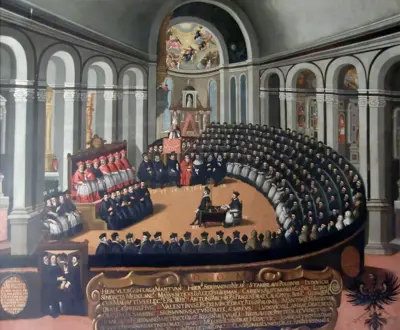
The Council of Trent (Latin: Concilium Tridentinum), held between 1545 and 1563 in Trent (or Trento, in northern Italy), was the 19th ecumenical council of the Catholic Church. Prompted by the Protestant Reformation, it has been described as the embodiment of the Counter-Reformation.
