George Rogers Clark Quotes
We are surrounded by numerous Indian nations, each more powerful than ourselves.
The British, with few troops in the West, armed Indians and paid for American scalps.
George Rogers Clark, 1752-1818, American Revolutionary War General, Brother of William Clark of the Lewis & Clark Expedition, Description of the Kentucky Territory, 1777
Sourced by: Eigen's Political and Historical Quotations


The Iroquois were generally recognized, even by the other tribes and nations, and the most advanced and most powerful of the Native Americans. Their example was critical in shaping the policies and behavior of all the Indians. At the time “Western” Indians referred to those in Pennsylvania, Ohio, Kentucky, Illinois and those West of the Eastern seaboard. West Coast and Plains Indians were not known generally known to the colonists and those nations had no knowledge of the Iroquois. Johnson himself married an Iroquois woman.


In early America large numbers of whites who had been captured by Indians would refuse to leave their new families even when they had the opportunity to do so. J. Hector St. John
Self Given Title. The governor distinguished between friendly Indians from others to the consternation of Bacon and his followers.


Many American leaders wanted to comply with and enforce the Indian treaties, but the remoteness made it difficult. There were always those whites who did not want to be restricted by Indian treaties who took advantage of the situation when there was a leader like Clinton who wanted to enforce the treaties. However in many cases, the American leadership really did not want to enforce the treaties and in some cases, as with President Andrew Jackson, wanted to abrogate the treaties with the Indians.

President Thomas Jefferson and the Congress worked at making a workable set of relationships with the Indians. Here Congress gave Jefferson a fund so that he could invite influential Indian leaders to Washington and give them presents. The hope was that the Indian leaders would see the achievements of white society and then work to transform their people to this more desirable way of life. While this was a good strategy with a few Indian nations, the reaction of most Indian leaders was being very impressed but not really wanting to trade their existing lifestyle, customs and values for the undeniable advantages that American society could bring. Both the white and Indian leadership miscalculated, Jefferson believed that as soon as the Indian leaders could examine the two alternative societies, they would clearly choose to change. The Indians were so impressed with the sincerity, reasonableness, and friendliness that the white leadership exhibited, that the Indians did not realize that a large part of white society was different from the leadership and that the leaders spoke for and could control the other whites.

The Lenape Tribe (Delaware Tribe) were the strongest Indian nation in America until they were supplanted by the Iroquois and then dominated by the Colonial whites who took much of their land. See {592309}.


This article was published under the name of “A Lover Of Peace” but is generally attributed to Paine. He was publishing in Pennsylvania which had a large Quaker, pacifist population and Paine was urging them to consider being armed.

12 Indians had originally come to the new colony from Massachusetts. Williams admitted them with the full rights, including voting rights, of the colonists and opened the way for other Indians who wanted to join. Although a minister and theologian, Williams created the first jurisdiction in America where there was freedom of religion.

Indian treaties had legal problems from the beginning of the nation. An agreement had been made at Fort Harmar with 6 Indian nations. One man signed for the United States and several of the sachems, for the Indians. President Washington reported this to the Senate and there was much confusion as to how to proceed. Typically, agents for nations negotiated a treaty but it would not be binding until each ratified it. To the Indians this was not a familiar practice. In this case, the treaty was approved for ratification by the Senate, but what kind of ratification was to be required of the Indians? The Iroquois Indian tribes had formal, methods of reaching consensus, but other nations did not. Whites sometimes reneged on later treaties on the grounds that they were not ratified by the Indian nations. In others, the Indians themselves made the same claim and challenged the right of the Indian treaty signers to speak for the tribe or nation. The problem has never been resolved.


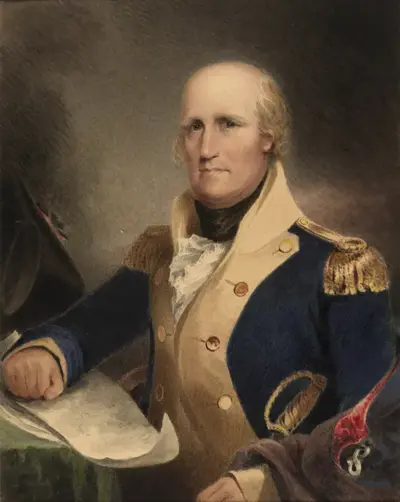
George Rogers Clark was an American surveyor, soldier, and militia officer from Virginia who became the highest-ranking American patriot military officer on the northwestern frontier during the American Revolutionary War. He served as leader of the militia in Kentucky (then part of Virginia) throughout much of the war. He is best known for his celebrated captures of Kaskaskia (1778) and Vincennes (1779) during the Illinois Campaign, which greatly weakened British influence in the Northwest Territory. The British ceded the entire Northwest Territory to the United States in the 1783 Treaty of Paris, and Clark has often been hailed as the "Conqueror of the Old Northwest".
